
A Species That Rewrote What We Thought We Knew About Great Apes
Few animals manage to be simultaneously one of the most feared figures in popular imagination and one of the gentlest, most family-oriented species in the animal kingdom. Mountain gorillas occupy exactly that contradiction, and closing the gap between the myth and the reality is part of what makes actually meeting one in the wild so disarming for first-time visitors.
When Dian Fossey began her long-term study of mountain gorillas in the Virunga Mountains in the late 1960s, much of what the wider world believed about these animals was wrong. They were assumed to be aggressive, unpredictable, closer to the movie-monster image of “gorilla” than to anything gentle or family-oriented. Decades of careful, patient research since then have replaced that image entirely, and what has emerged is one of the most quietly remarkable species on the African continent: an animal capable of grief, humor, tool use and deep social bonds, living in some of the most demanding terrain any great ape calls home.
Mountain gorillas are not simply “big gorillas.” They are a distinct subspecies, Gorilla beringei beringei, adapted specifically to high-altitude forest life in a way their lowland cousins in Central Africa’s rainforest basins are not. Understanding what actually makes them so compelling means looking past the size and the headlines about endangered status, into the specific biology and behavior that sets this subspecies apart.
A Species Defined By Its Habitat
Where Mountain Gorillas Actually Live
Mountain gorillas exist in exactly two isolated populations on Earth, and nowhere else. One lives across the Virunga Massif, a chain of volcanoes spanning the borders of Rwanda, Uganda and the Democratic Republic of Congo. The second, and slightly larger, population lives entirely within Uganda’s Bwindi Impenetrable National Park, an ancient forest that predates the last ice age and has never been connected to the Virunga range. No mountain gorillas exist in zoos anywhere in the world. Every single individual of this subspecies lives wild, in one of these two forest systems, which is part of why the population figures conservationists track are treated with such seriousness.
Life At Altitude
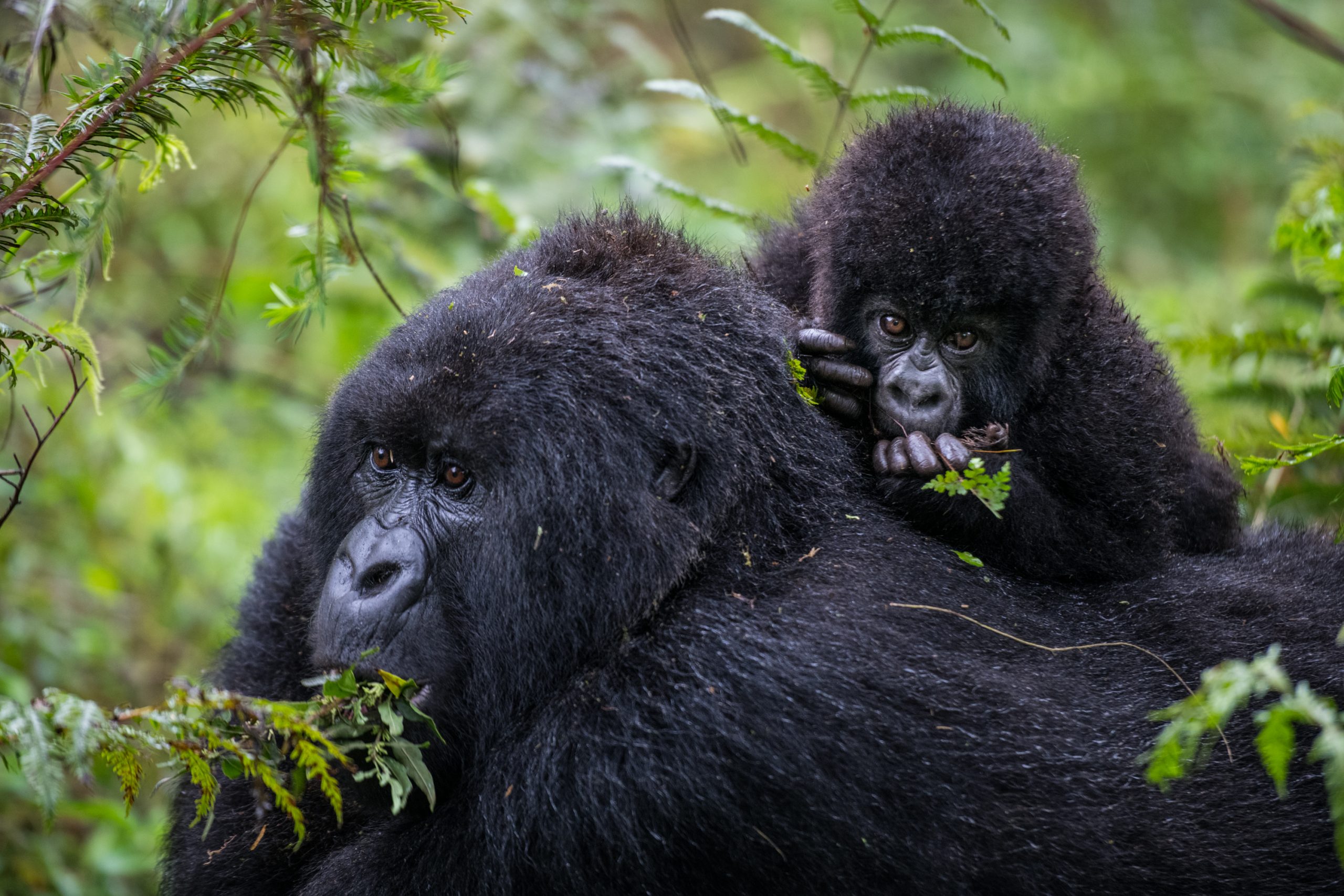
Both habitats sit at elevations between roughly 2,200 and 4,300 meters, cool, misty, montane forest rather than the hot lowland jungle most people picture when they think of gorillas. This altitude shapes everything about the subspecies physically. Mountain gorillas carry noticeably thicker, longer fur than lowland gorillas, an adaptation to nights that can drop close to freezing even near the equator. Their diet shifted accordingly too. Fruit, the dietary mainstay of lowland gorillas, is scarce at this elevation for much of the year, so mountain gorillas rely far more heavily on leaves, stems, bamboo shoots and bark, foraging through dense vegetation for hours each day to meet their nutritional needs.
The Social Structure That Sets Them Apart
The Role Of The Silverback
A mountain gorilla family, more accurately called a troop, is organized around one dominant adult male, identifiable by the distinctive silver-grey saddle of hair that develops across his back once he reaches full maturity around twelve to fifteen years old. The silverback’s role goes well beyond simple dominance. He decides where the group forages each day, mediates disputes between members, defends the troop against rival males and predators, and in most troops, fathers the majority of infants born within it. When a silverback dies, troops sometimes fracture entirely, with females and young dispersing to join other groups, which is one reason researchers track individual silverbacks so closely across their decades-long lifespans.
Family Bonds Across Generations
What surprises many first-time trekkers is how visibly affectionate mountain gorilla troops are with each other. Grooming is constant and clearly serves a social bonding function well beyond hygiene. Juveniles wrestle and chase each other through the undergrowth in play that looks remarkably close to human children at a playground. Mothers carry infants for the first several months of life and maintain close physical contact for years afterward, with young gorillas typically staying within the natal troop until early adulthood. Long-term studies have documented individuals showing what researchers describe as grief-like behavior after the death of a troop member, sitting near the body, touching it gently, subdued for days afterward.
Intelligence And Communication
Mountain gorillas communicate through more than twenty distinct vocalizations, each tied to a specific context: a low, rhythmic belching sound used during peaceful feeding, sharp barks signaling alarm, and a range of grunts used to coordinate movement and reassure troop members during tense encounters with rival groups. Beyond vocal communication, gorillas rely heavily on body posture, facial expression and touch, a communication system sophisticated enough that experienced trackers can often read a troop’s mood from a distance before a single vocalization is made.
Tool use, once thought to be a uniquely chimpanzee behavior among great apes, has also been documented among wild gorillas, including using sticks to test water depth and branches as makeshift bridges across muddy or unstable ground. None of this places gorillas above other great apes in some abstract intelligence ranking. What it does is confirm that the cognitive sophistication long associated with chimpanzees and bonobos extends to gorillas as well, a relatively recent shift in scientific understanding that trekkers now get to witness firsthand.
Genetic Closeness To Humans
Mountain gorillas share somewhere close to ninety-eight percent of their DNA with humans, a figure that explains a great deal about both the emotional impact of encountering one in the wild and the very real health risks the relationship creates. That genetic closeness means gorillas are susceptible to many human respiratory illnesses, sometimes with far more serious consequences for them than the same illness would cause in a person. It is the entire basis for the strict health protocols around gorilla trekking: the seven-metre minimum viewing distance, the requirement that visibly unwell trekkers sit a day out, and the careful limits on group sizes and visiting duration. These are not arbitrary bureaucratic rules. They exist because the same closeness that makes the encounter so moving also makes the animals genuinely vulnerable to us.
How Mountain Gorillas Differ From Their Lowland Relatives
Gorillas as a whole are split into two species and four subspecies, and mountain gorillas are only one branch of that family tree. Western lowland gorillas, the subspecies most commonly seen in zoos worldwide, live across the rainforest basins of countries like Gabon, Cameroon and the Central African Republic, at far lower elevations and in noticeably warmer, wetter conditions. They tend to be somewhat smaller and browner in coloring than mountain gorillas, with a more pronounced reliance on fruit where it is seasonally abundant.
Eastern lowland gorillas, sometimes called Grauer’s gorillas, occupy a middle ground both geographically and physically, found in the lowland and montane forests of eastern DRC. Practically speaking for a traveller, the distinction matters most when planning where to trek. Seeing a mountain gorilla specifically means Uganda, Rwanda or DRC’s Virunga sector. Seeing a western lowland gorilla means a Central African itinerary through the Congo Basin countries instead, a genuinely different trip in terms of terrain, logistics and even the visual experience of the encounter itself.
Conservation Success Against The Odds
Mountain gorillas hold a rare distinction among the world’s great apes: their population has been growing rather than shrinking. Estimates in the 1980s put the total wild population at barely 250 individuals, a number low enough that extinction within a generation seemed like a real possibility. Sustained conservation work, anti-poaching patrols, veterinary intervention for injured or sick individuals, and revenue from carefully regulated tourism, has pushed that number past 1,000 today, enough that mountain gorillas were formally reclassified from Critically Endangered to Endangered in 2018, a genuinely rare piece of good news in great ape conservation.
Tourism is not incidental to that recovery. Trekking permit revenue funds a significant share of the ranger patrols, veterinary teams and habitat protection work responsible for the population’s rebound, and a portion reaches the communities living along the park boundaries directly, giving local populations a tangible economic stake in the forest’s survival rather than in clearing it. Our conservation and educational tours go into this work in more depth for travellers who want to understand it beyond the trekking experience itself.
How To See Mountain Gorillas For Yourself
Every wild mountain gorilla left on Earth lives across the same handful of protected forests in Uganda, Rwanda and DRC, which means seeing one always means visiting one of these three countries specifically, not a wider “African safari” in the generic sense. Standard trekking gives you a fixed hour with a habituated troop, reachable via mountain gorilla trekking tours running in all three countries. Travellers wanting a longer, deeper encounter can look at the gorilla habituation experience, currently available only in Uganda’s Rushaga sector, which extends the visit to up to four hours alongside the team still building trust with a troop.
Whichever route you choose, the encounter itself tends to leave a similar impression: an animal far calmer, far more familiar and far more clearly individual than its size and reputation suggest. If you want help deciding which country, season or trekking style fits your specific trip, reach out through our contact page and we will talk through the options with you directly.