
The Ape That Forced Science To Rethink What Makes Us Human
For most of the twentieth century, tool use, warfare and complex political alliances were considered defining traits of humanity alone. Jane Goodall’s decades of field work at Gombe Stream, beginning in 1960, dismantled that assumption almost entirely, documenting wild chimpanzees stripping leaves from twigs to fish termites from their mounds, forming shifting political coalitions to seize troop leadership, and in some cases waging sustained, lethal conflict against neighbouring communities. Few discoveries have done more to blur the line between human and animal behaviour than the ongoing study of wild chimpanzees.
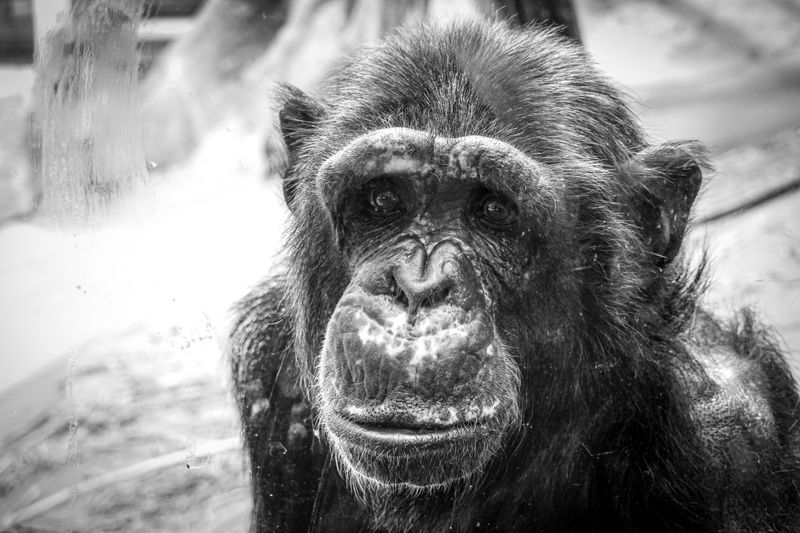
Chimpanzees share roughly ninety-eight to ninety-nine percent of their DNA with humans, making them our closest living relatives alongside bonobos. That closeness shows up constantly in the field: in the way a chimpanzee community organizes itself, in the individual personalities trackers learn to recognise across repeat visits, and in behaviour that feels startlingly familiar even to first-time observers.
Where Chimpanzees Actually Live
Individual chimpanzee communities can hold territories spanning many square kilometres of forest, and boundary disputes between neighbouring communities are taken seriously enough that males regularly patrol territorial edges in small, cautious groups, listening and scanning for signs of rival community members before advancing. These patrols occasionally escalate into violent encounters when patrolling males catch a lone individual from a neighbouring community, behaviour that researchers have documented leading to serious injury and even death in rare cases. It is a sobering counterpoint to the gentler, more familiar social moments visitors typically witness on a standard trek, and a reminder that chimpanzee society, for all its behavioural similarity to our own, operates by its own set of rules shaped by millions of years of separate evolution.
A Wider Range Than Gorillas
Unlike mountain gorillas, confined to two small forest systems, chimpanzees range across a much broader swath of equatorial Africa, from Guinea in the west to western Tanzania in the east. Within our destination countries, Uganda’s Kibale National Park holds the highest chimpanzee density anywhere in East Africa, while Rwanda’s Nyungwe Forest and Tanzania’s remote Mahale Mountains and Gombe Stream National Parks each support their own distinct, well-studied communities.
Forest Canopy Specialists
Chimpanzees spend considerably more time in the forest canopy than gorillas do, building fresh sleeping nests high in the trees each night and foraging through multiple canopy layers during the day. This arboreal habit, combined with their speed and tendency to move in smaller, more spread-out foraging parties than a gorilla troop, is part of why chimpanzee trekking often involves following calls through dense forest before ever spotting an individual.
A Fluid, Political Social Structure
Fission-Fusion Communities
Chimpanzee communities operate on what researchers call a fission-fusion system: a large community, sometimes fifty or more individuals, that rarely travels together as one group. Instead, smaller subgroups form and dissolve throughout the day based on food availability, social relationships and reproductive activity, making the composition of any given sighting somewhat unpredictable even within a well-studied, habituated community.
Shifting Alliances And Rank
Unlike the relatively stable, silverback-led hierarchy of a gorilla troop, chimpanzee status is won and defended through shifting political coalitions between males, sometimes involving years of strategic alliance-building before a challenger successfully displaces an alpha. Females maintain their own separate social relationships and can wield considerable influence over community dynamics despite males generally holding the more visible top-ranking positions.
Tool Use And Problem-Solving
Wild chimpanzees across different regions have developed distinct, learned tool traditions passed down through generations, not universal instinct. Termite-fishing with modified twigs, using stones as hammers and anvils to crack open hard-shelled nuts, and chewing leaves into an absorbent sponge to soak up water from tree hollows all vary by population, evidence of genuine cultural transmission rather than simple hardwired behaviour. This regional variation is one of the most studied phenomena in primatology, since it suggests something functionally similar to human cultural diversity operating in a wild ape population.
Hunting Behaviour That Surprises First-Time Visitors
Chimpanzees are not strict herbivores, and while fruit and leaves make up the bulk of their diet, wild chimpanzee communities in several well-studied populations regularly hunt smaller mammals, most often red colobus monkeys, in coordinated group efforts involving multiple males working together to corner and capture prey in the canopy. This hunting behaviour, first documented systematically at Gombe, was another finding that reshaped assumptions about chimpanzee diet and social cooperation, since successful hunts also involve complex meat-sharing dynamics within the community that researchers have studied closely as a window into chimpanzee social bonds and political favour-trading. Not every chimpanzee population hunts with equal frequency, and the behaviour varies meaningfully by region and by the local availability of suitable prey, another example of the cultural variation seen across different wild chimpanzee communities.
Communication Far Beyond The Famous Pant-Hoot
The chimpanzee pant-hoot, a rising, drumming call often accompanied by hitting tree buttresses, carries for over a kilometre through dense forest and serves to announce location, reunite scattered subgroups and occasionally intimidate rivals. Beyond this signature call, chimpanzees use an extensive vocabulary of grunts, screams and barks alongside detailed facial expressions and gestures, a communication system detailed enough that experienced researchers can often identify which individual is calling from voice alone.
Chimpanzees Compared To Bonobos
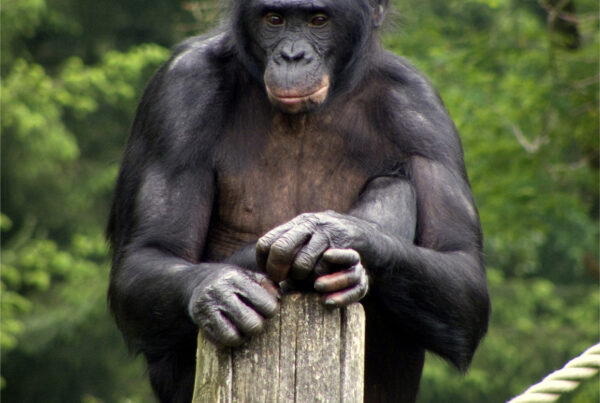
Chimpanzees are often discussed alongside bonobos as humanity’s two closest living relatives, and while the two species look superficially similar, their social behaviour diverges sharply. Bonobo society, found only south of the Congo River in the Democratic Republic of Congo, is generally described as more female-dominant and less violently competitive between males than chimpanzee communities, which can display sustained lethal aggression, including coordinated boundary patrols against neighbouring communities. Chimpanzees split from the bonobo lineage roughly two million years ago, likely after the Congo River formed a barrier separating the two populations, and the two species have never been observed interbreeding in the wild since. For travellers, the practical distinction is largely geographic: chimpanzee trekking is available across our East African destinations, while bonobos remain confined to DRC and are not currently part of our standard tour offering.
Four Decades Of Research At Gombe And Kibale
Much of what is known about wild chimpanzee behaviour traces back to a small number of long-running research sites, chief among them Gombe Stream in Tanzania, where Jane Goodall’s original 1960 study continues today as one of the longest continuous studies of any wild mammal population, and Kibale National Park in Uganda, home to multiple habituated communities studied since the 1980s. This sustained research presence has done more than generate scientific papers. It has kept a constant, protective human presence in these forests for decades, made individual chimpanzees recognisable enough that guides can point out specific, well-known personalities to visiting trekkers, and generated the detailed behavioural baseline that lets researchers detect subtle signs of stress, illness or unusual behaviour in a troop today.
Conservation Status And Ongoing Threats
Chimpanzees are currently classified as Endangered, with population declines driven primarily by habitat loss as forest is cleared for agriculture, alongside poaching and disease transmission from nearby human populations. Unlike mountain gorillas, chimpanzees have not seen a comparable population rebound, making the tourism revenue and habitat protection funded by trekking permits an increasingly important part of the conservation picture across their range. Long-term research stations like those at Kibale, Gombe and Mahale also double as some of the most effective anti-poaching presences in their respective forests, simply through the constant human activity they maintain in the area.
What A Chimpanzee Trekking Day Actually Feels Like
Where a gorilla trek often ends in a still, quiet family scene, a chimpanzee trek tends to stay dynamic even once you have found the community. Individuals may be feeding high in the canopy one moment and moving rapidly through the understory the next, calling to distant subgroups, grooming in pairs, or, occasionally, breaking into the kind of vocal chorus that can genuinely startle first-time visitors with its volume and intensity. Trackers often locate a community using a combination of fresh nest sites, feeding remains and, most reliably, the sound of pant-hoots carrying through the forest, sometimes adjusting the day’s route significantly based on where a call is heard from. This unpredictability is part of the appeal for repeat visitors, since no two chimpanzee treks tend to unfold quite the same way, even when visiting the same community on consecutive days.
Seeing Chimpanzees For Yourself
Whichever community and country you visit, a chimpanzee trek rewards patience and a willingness to keep moving, since the encounter rarely comes to you the way a settled gorilla family sometimes does. Standard chimpanzee trekking tours run across Uganda, Rwanda and Tanzania, giving you a full hour with a habituated community once trackers locate them. For a deeper look at the research and habituation process itself, our chimpanzee habituation experience in Kibale follows a community from dawn until they settle into their nests for the night. Many travellers combine either option with a mountain gorilla trek in the same region, since Kibale sits close enough to Bwindi to fit both into a single itinerary without excessive travel time. Get in touch through our contact page if you would like help building that itinerary around your dates.