
The Guenon That Prefers Mountains To Lowland Rainforest
The species is named after Belgian mining engineer Laurent-Joseph-Adolphe-Marie Louis L’Hoest, who first collected a specimen in the late nineteenth century while working in the region, one of several African primates carrying a colonial-era European name attached during the period when much of the continent’s wildlife was first being formally catalogued by Western science, a naming history worth understanding as context even though it has no bearing on the animal’s actual behaviour or ecology today.
Most guenon species are associated with lowland or mid-altitude tropical forest, which is part of what makes L’Hoest’s monkey such an interesting outlier within its own genus. Found primarily in the montane and submontane forests of the eastern Congo Basin, including parts of Uganda, Rwanda and the Democratic Republic of Congo, L’Hoest’s monkey has adapted to cooler, higher-elevation forest conditions that most of its guenon relatives simply do not occupy, a habitat preference closer to what mountain gorillas require than to the lowland rainforest favoured by species like De Brazza’s monkey or the various guenons found further west in the Congo Basin.
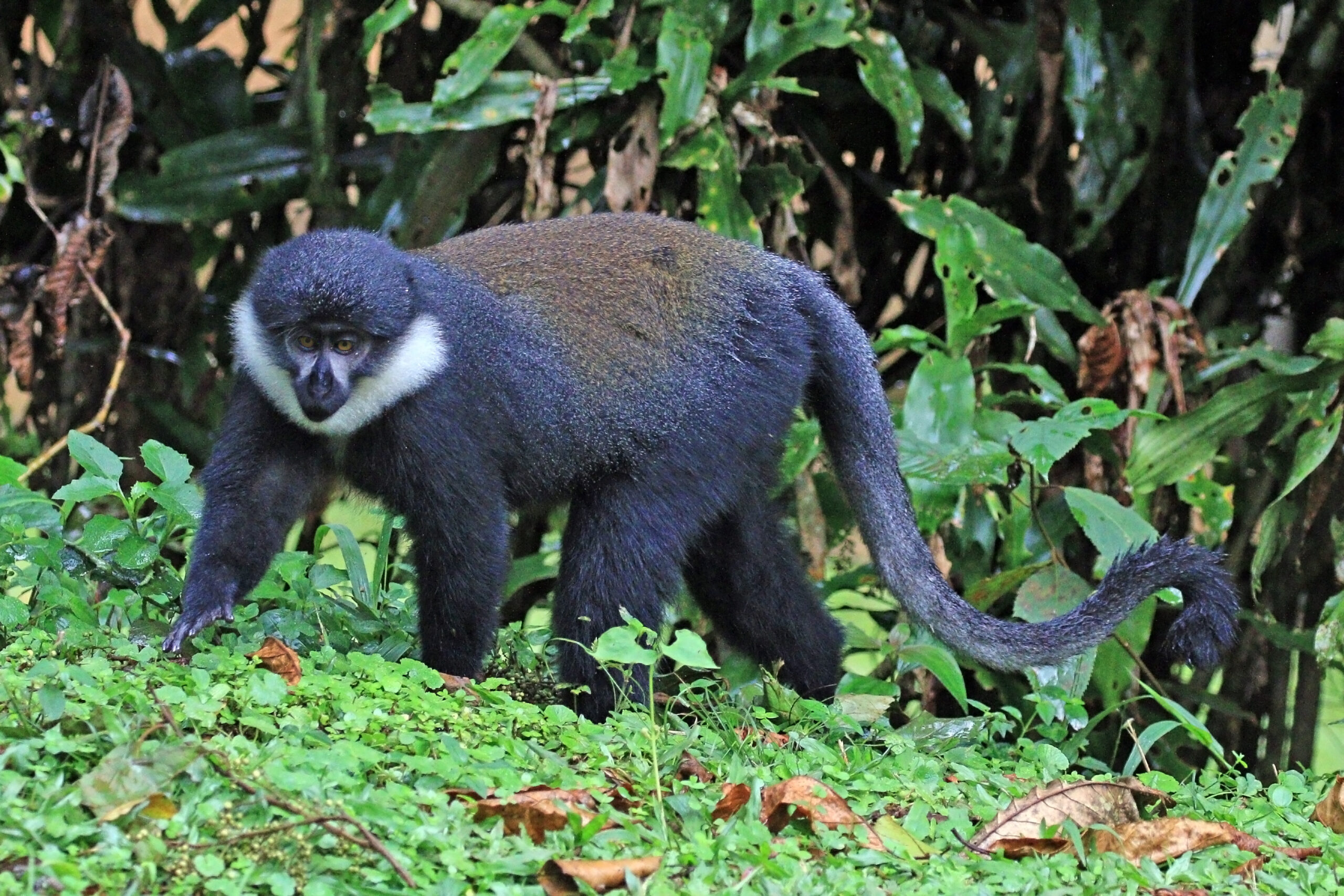
A dark, blackish-grey coat, a distinctive white throat patch and beard framing the face, and a habit of moving through dense undergrowth close to the forest floor rather than high in the canopy give L’Hoest’s monkey, sometimes called the mountain monkey for exactly this habitat preference, a genuinely different character from most other guenons discussed elsewhere in this series.
A Genuinely Restricted, High-Altitude Range
This narrow habitat requirement means L’Hoest’s monkey distribution maps closely onto some of the same protected montane forest blocks that already draw travellers for entirely different reasons, namely gorilla and golden monkey tracking, rather than requiring an entirely separate destination or itinerary detour. Conservation planning across this shared habitat zone increasingly treats the montane forest ecosystem as a single interconnected unit rather than managing each species’ protection separately, since the same forest blocks support all three species simultaneously.
Forests Most Other Guenons Avoid
L’Hoest’s monkeys occupy montane forest at elevations that overlap closely with mountain gorilla and golden monkey habitat in places, a cooler, wetter forest environment than the lowland conditions most guenon species prefer. This habitat specialisation restricts L’Hoest’s monkey to a considerably narrower overall range than more habitat-flexible guenon species, confined largely to the mountainous forest belt running through eastern DRC, Uganda’s southwest and small pockets of Rwanda and Burundi.
A Ground-Oriented Guenon
Unlike many guenon species that spend the bulk of their time in the mid-to-upper canopy, L’Hoest’s monkeys forage extensively on or near the forest floor, moving through dense understory vegetation in a manner closer to some ground-dwelling primates than to typical canopy-dwelling guenons. This ground-level habit makes them somewhat easier for guides to spot on a forest walk than more strictly arboreal guenon species, though the same dense understory vegetation they favour can also make for a more obstructed, briefer sighting than a clear canopy view might offer.
Social Structure And Behaviour
Male takeover events, when a challenging male successfully displaces the resident male of a troop, can be a genuinely tense and occasionally violent process, and researchers studying these transitions have noted that incoming males sometimes display aggression toward infants fathered by the previous resident male, a pattern documented across several primate species with single-male social structures and generally understood as a strategy that shifts females back into reproductive readiness sooner under the new male’s tenure, however unsettling the behaviour appears to human observers witnessing it directly.
L’Hoest’s monkey troops are typically organised around a single resident adult male accompanying a group of related females and their offspring, a social structure that shifts periodically as resident males are challenged and occasionally displaced by rival males from outside the troop. Group sizes tend to run smaller than many other guenon species, generally under twenty individuals, consistent with a pattern seen in several other primate species whose foraging strategy depends on moving quietly and inconspicuously through dense ground-level vegetation rather than the more visible, higher-canopy movement other guenons rely on.
Diet Adapted To The Forest Floor
This ground-level foraging strategy places L’Hoest’s monkeys in more direct dietary overlap with other terrestrial and semi-terrestrial forest species, including forest-dwelling duiker antelope in some areas, than most canopy-committed guenons ever experience, an ecological positioning that has made the species an occasional subject of broader forest-floor community studies looking at how multiple ground-foraging species partition limited food resources within the same patch of montane forest.
Fruit still makes up a significant part of the L’Hoest’s monkey diet, supplemented by leaves, fungi and a notably higher proportion of terrestrial invertebrates than many canopy-dwelling guenon species consume, a dietary adaptation that follows naturally from spending so much foraging time at or near ground level rather than high in the fruit-bearing canopy layers other guenons specialise in exploiting.
Conservation Status And Habitat Vulnerability
Because L’Hoest’s monkey habitat overlaps so closely with land also suitable for mountain gorilla and golden monkey conservation, protection efforts targeting those two better-known, higher-profile species tend to benefit L’Hoest’s monkey populations indirectly, an example of how conservation investment in a flagship species can carry meaningful secondary benefits for lesser-known primates sharing the same protected forest, even without dedicated funding or attention specifically directed at the less famous species itself.
L’Hoest’s monkey is currently classified as Vulnerable, a more serious status than most other guenon species carry, driven by its naturally restricted montane habitat range combined with ongoing deforestation pressure across parts of its distribution, particularly in areas where agricultural expansion has encroached on mid-altitude forest. This restricted range and elevated conservation status make L’Hoest’s monkey one of the more genuinely threatened guenon species encountered across our destination countries, despite lacking the wider name recognition that species like golden monkeys or mountain gorillas, sharing similar montane habitat, tend to receive.
A Sighting That Rewards Patience
Experienced guides often compare tracking L’Hoest’s monkeys to a quieter, more deliberate version of gorilla trekking, relying on subtle signs, disturbed leaf litter, distant rustling, occasional soft contact calls, rather than the more obvious visual and auditory cues that make locating a golden monkey troop or a chimpanzee community comparatively straightforward. This slower pace is not a drawback so much as a genuinely different style of wildlife encounter, one that rewards travellers who enjoy the process of tracking itself rather than treating it purely as a means to a guaranteed sighting at the end.
A Distinctive Addition To A Broader Itinerary
Guides who have spent years working the same montane forest routes often develop a genuine fondness for pointing out L’Hoest’s monkeys specifically, precisely because so few visitors arrive already knowing the species exists, making the introduction itself part of the experience rather than a checklist confirmation of something already anticipated from pre-trip research.
Because L’Hoest’s monkeys are neither as globally recognised as mountain gorillas nor as consistently marketed as golden monkeys, encountering one often feels like a genuine discovery for travellers who did not arrive with the species specifically on their checklist, an experience several of our guides describe as one of the more quietly memorable moments on a longer Uganda or Rwanda itinerary precisely because it arrives without the built-up expectation that surrounds the headline species most visitors plan their entire trip around.
Because L’Hoest’s monkeys favour dense ground-level cover and tend to be more naturally cautious around human observers than some habituated forest species, sightings often require a slower, quieter approach than a typical guenon or colobus encounter, with guides relying as much on listening for movement in the undergrowth as on visual scanning of the canopy above. This is a species that rewards travellers willing to move at a deliberately unhurried pace through the forest rather than expecting the more immediate, visible sightings a habituated gorilla or chimpanzee trek typically delivers.
What To Expect On The Day
Comfortable, quiet-footed walking shoes matter more here than on a typical nature walk, since sudden noise is one of the more reliable ways to send a foraging troop deeper into cover before a clear view is possible.
A forest walk built around finding L’Hoest’s monkeys generally moves at a slower pace than a standard nature walk, with guides pausing frequently to listen and scan the understory rather than covering ground quickly toward a known troop location the way a permitted gorilla or chimpanzee trek does. Visitors should expect a walk measured in patient attentiveness rather than distance covered, and treat any sighting, however brief or partially obscured by vegetation, as a genuine success given how naturally cautious and ground-hugging this particular species tends to be compared to more visible canopy-dwelling guenons.
Seeing L’Hoest’s Monkeys For Yourself
L’Hoest’s monkeys turn up on forest walks in the montane sections of Uganda’s southwest forests and Rwanda’s higher-elevation forest reserves, often in the same general habitat zone as golden monkey tracking excursions. They feature as a possible sighting on our forest monkey tracking and nature walk tours, though given their more cautious nature and restricted range, we recommend mentioning L’Hoest’s monkeys specifically when planning your itinerary through our contact page, so your guide can build in the slower, quieter approach this particular species tends to require.