
The Fastest Primate On Earth
That speed record is not simply a trivia fact. It reflects a genuinely different evolutionary bet than almost every other primate on this list has made. Where gorillas, chimpanzees and most monkeys rely on some combination of size, social cooperation, canopy access or camouflage to manage predator risk, patas monkeys effectively opted out of those strategies in favour of raw, sustained sprint speed, a solution that works remarkably well in open country but would offer little protection in the dense forest habitats most of their primate relatives call home.
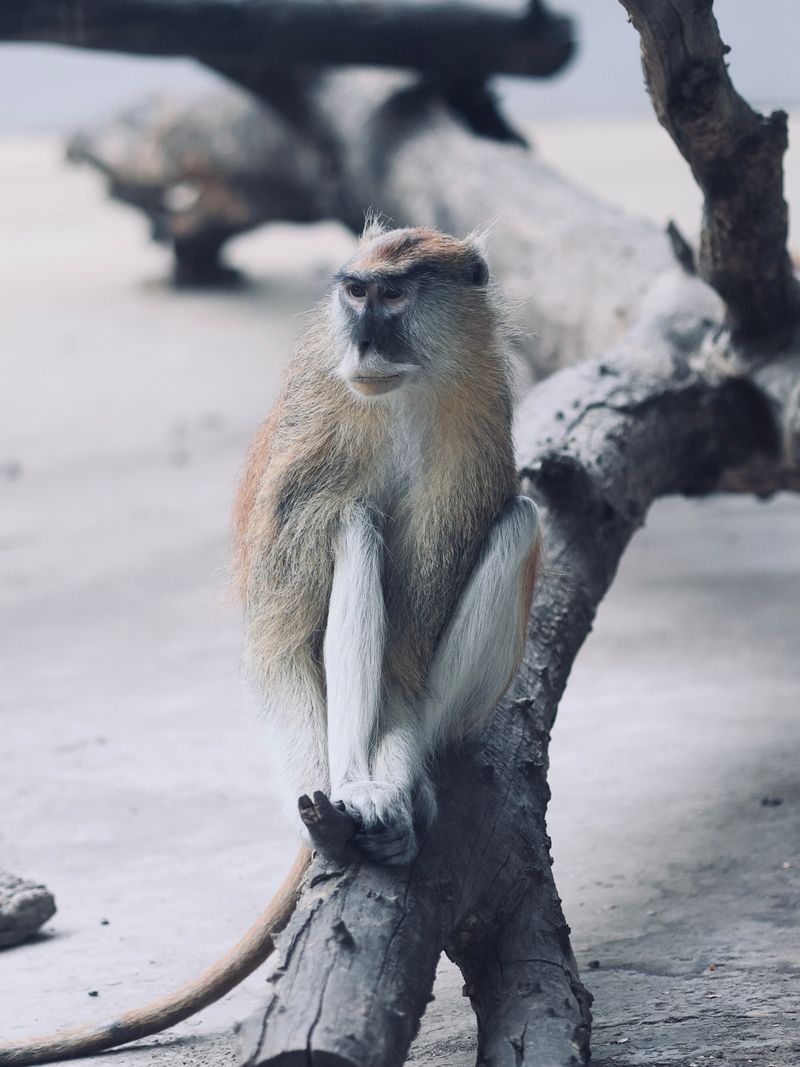
Most primates encountered on an African safari are built for climbing, leaping or careful arboreal balance. The patas monkey is built for something else entirely: flat-out sprinting across open ground, a specialisation so pronounced that patas monkeys hold the distinction of being the fastest primate on the planet, with recorded speeds reported well in excess of fifty kilometres per hour across short bursts on open terrain. Everything about their body plan, from unusually long limbs relative to body size to a lean, greyhound-like build, reflects an evolutionary strategy built almost entirely around one core skill: outrunning danger in landscapes with almost nowhere to hide.
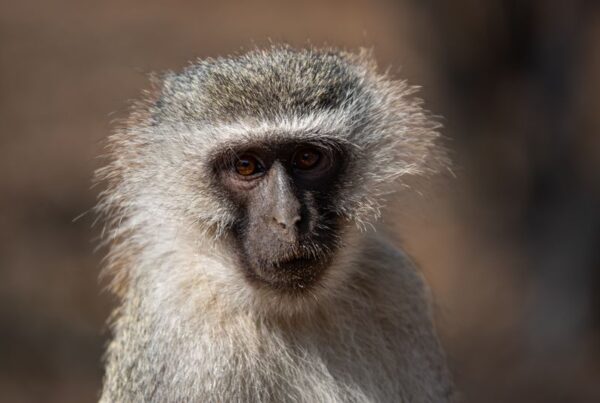
Reddish-orange fur across the back, a stark white underside and a distinctive black-and-white facial pattern with a pale brow give patas monkeys a look genuinely distinct from the greyer, more forest-adapted vervet monkeys they are sometimes mistaken for by first-time visitors.
A Monkey That Chose The Savannah Over The Trees
This preference for open country puts patas monkeys in direct ecological contrast with nearly every other guenon-family species discussed elsewhere on this site, since the genus as a whole is overwhelmingly forest and woodland adapted. Patas monkeys represent something close to an evolutionary outlier within their own broader family group, having adapted to a habitat type that would expose most of their close relatives to far greater predation risk than they are built to survive.
Living Where Trees Are Scarce
Patas monkeys occupy dry savannah, semi-arid grassland and scattered woodland across a wide band of sub-Saharan Africa, deliberately favouring open terrain that most other primates avoid due to the lack of cover from predators. This habitat choice is unusual enough among primates that patas monkeys are sometimes described as having taken the opposite evolutionary path from most of their forest-dwelling relatives, trading climbing ability and canopy access for terrestrial speed and stamina.
Sparse Trees, Specific Purposes
The scattered trees that do exist within patas monkey range still matter enormously, serving primarily as sleeping sites at night and as vantage points during the day for spotting approaching predators, rather than as a primary foraging habitat the way they are for more arboreal species. A troop typically selects a different sleeping tree each night, a strategy thought to reduce the risk of predators learning and exploiting a predictable roosting location over time.
Speed As The Primary Survival Strategy
This reliance on speed over concealment or cooperative defence also shapes how patas monkeys respond to human observers on safari, typically maintaining greater flight distance than more habituated forest primates and moving away quickly at the first sign of a vehicle or walking group approaching too directly. Guides experienced with patas monkey sightings generally recommend a slower, more gradual approach and longer viewing distance than would be appropriate for a habituated gorilla or chimpanzee troop, since pushing the distance too aggressively simply triggers the group’s default sprint response and ends the sighting prematurely.
Where a vervet monkey’s default response to a ground predator is to climb the nearest tree, a patas monkey’s default response is to run, often leading predators on a extended, high-speed chase across open ground before doubling back or losing pursuit entirely through sheer sustained speed. This strategy places a premium on early predator detection, which is likely part of why patas monkeys tend to forage across unusually large home ranges relative to their body size, spreading out to maximise the group’s collective ability to spot danger before it closes the distance.
The Vigilance Behaviour That Defines The Species
Patas monkeys have been observed engaging in a distinctive sentinel-like behaviour, with individuals periodically climbing onto termite mounds, fallen logs or the tallest available vantage point to scan the surrounding terrain before rejoining the group’s foraging activity. This active, deliberate vigilance behaviour is more pronounced and more frequently documented in patas monkeys than in most other African monkey species, a direct behavioural consequence of living in terrain that offers so little natural cover from approaching predators compared to a forest environment.
An Unusual Social Structure Among Old World Monkeys
Researchers studying patas monkey social organisation have noted this structure sits somewhere between the strict multi-male hierarchies of baboons and vervets and the more variable arrangements seen in some other savannah-adapted mammals, making patas monkeys a useful comparative case study for understanding how mating system and social structure relate to a species’ specific ecological pressures, in this case the premium placed on rapid, coordinated group movement across open, exposed terrain.
Patas monkey troops typically consist of multiple related females and their offspring accompanied by a single resident adult male for much of the year, a harem-style structure less common among African monkey species than the multi-male troops seen in baboons or vervets. Outside the breeding season, this resident male role can shift, with some populations showing more flexible male association patterns than the strict single-male structure suggests at first glance. Females generally remain within their natal group across their lifetime, while males disperse upon reaching maturity, a pattern consistent with the broader Old World monkey tendency toward female group stability and male transfer.
A Wide Range Spanning The Sahel And Beyond
This tolerance for a wide range of savannah conditions has helped patas monkeys avoid the sharp population declines documented in more habitat-restricted African primates, though it does mean local population density can vary considerably across their range depending on specific rainfall, vegetation cover and predator density in any given area, factors that guides account for when advising which specific region of a country offers the best realistic chance of a sighting on a given trip.
Patas monkeys hold one of the widest east-to-west ranges of any African primate, occurring in suitable savannah and semi-arid habitat from West Africa’s Sahel belt through to parts of East Africa, a distribution pattern shaped almost entirely by the availability of open, tree-scattered terrain rather than any single country or region’s specific ecology. This broad range means patas monkeys tolerate a wider variety of climate and rainfall conditions than most other African primates discussed in this series, from the more humid savannah margins of East Africa to considerably drier Sahelian habitat further west and north.
Conservation Status And Regional Pressure
Patas monkeys are currently classified as Least Concern across most of their wide range, benefiting from a habitat preference that overlaps less directly with the intensive agricultural conversion pressure facing more forest-dependent primate species. That said, localised populations face genuine pressure in areas where savannah habitat is converted to farmland or grazing land, and their reliance on scattered trees for safe sleeping sites means even moderate deforestation in otherwise open habitat can meaningfully affect a local population’s safety and behaviour.
A Species Often Overlooked On Standard Itineraries
Early morning tends to offer the best realistic chance of a sighting, when troops are actively foraging in cooler temperatures before the heat of the day pushes them toward whatever shade the sparse savannah trees provide, a window guides familiar with local patas populations plan around specifically rather than leaving to chance during a longer game drive.
Because patas monkeys are more skittish and less reliably encountered than habituated forest primates, they rarely feature as a headline species in trip planning the way gorillas or chimpanzees do, and many general safari itineraries pass through suitable patas habitat without a dedicated effort to seek them out. Travellers with a genuine interest in African primate diversity beyond the more commonly marketed species often find patas monkeys one of the more satisfying additions to an itinerary precisely because the sighting requires a bit more attention and luck than the more routinely guaranteed encounters elsewhere on a standard trip.
Seeing Patas Monkeys For Yourself
For travellers building an itinerary around genuine primate diversity rather than a single headline species, mentioning patas monkeys specifically when planning is worth doing early, since it lets us route your savannah days through the areas where local populations are best established rather than leaving the sighting purely to chance. Patas monkey sightings typically occur as part of a broader savannah wildlife experience rather than a dedicated primate trek, often alongside baboons and vervets on our baboon and savannah primate observation tours across suitable open-country destinations. Because they are considerably more skittish and fast-moving than most primates on a typical itinerary, a patient guide and a bit of luck matter more here than with more habituated forest species. Reach out through our contact page if patas monkeys are a specific priority for your trip and we will factor that into route planning.