
A Voice That Carries Further Than Almost Any Other Forest Primate
Guides working in forests where grey-cheeked mangabeys are present often describe the whoop-gobble call as one of the most distinctive sounds of an early morning forest walk, delivered in a rhythmic pattern that experienced trackers can distinguish from the calls of other resident primates almost instantly, even from considerable distance and through dense vegetation that obscures any visual confirmation. This vocal reliability makes mangabeys one of the more consistently locatable forest primates on a guided walk, since a troop’s approximate position can often be triangulated from a call alone well before trackers commit to a specific direction of pursuit.
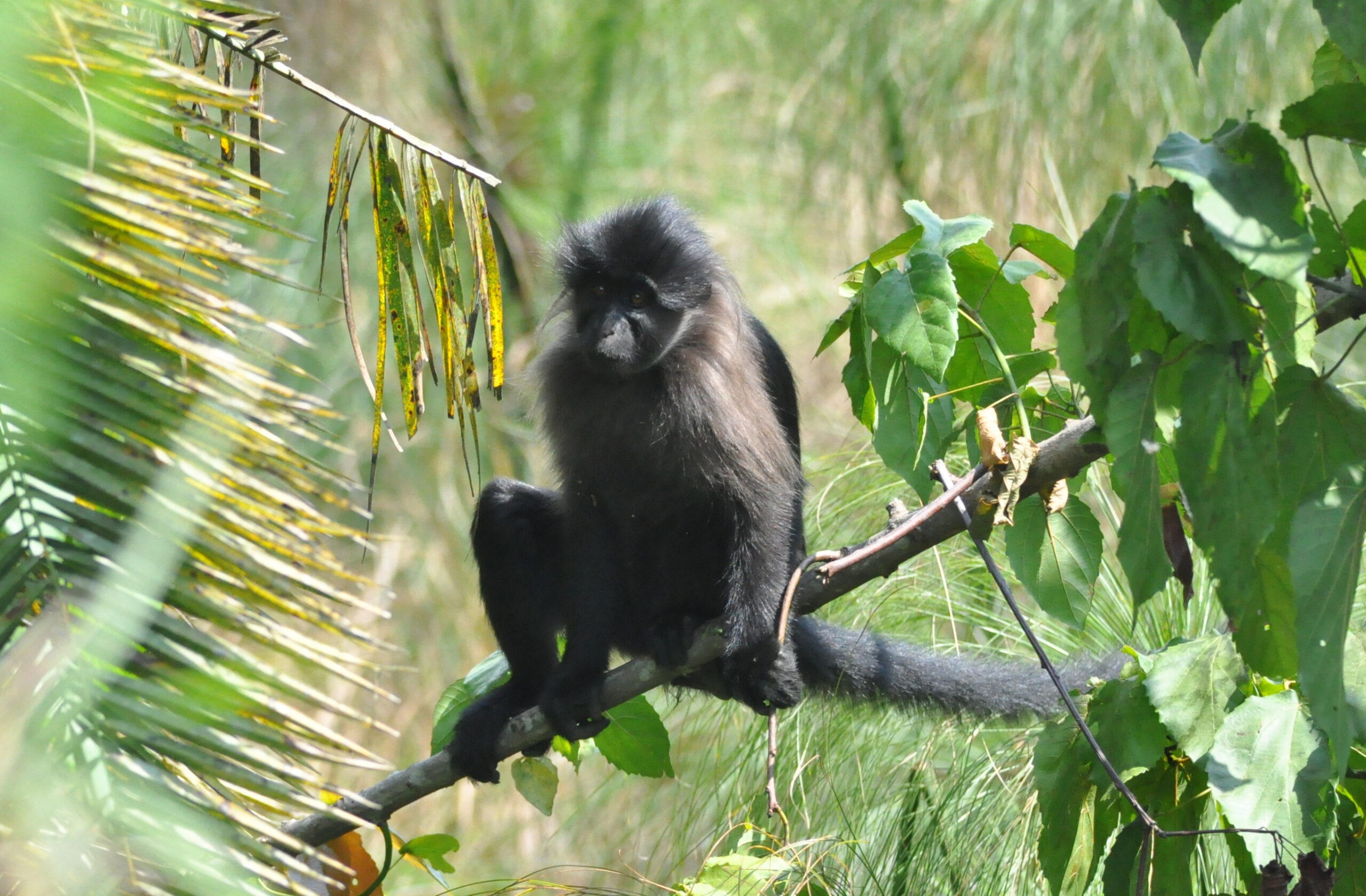
Long before a grey-cheeked mangabey is visible through the canopy, it is often audible from a considerable distance, thanks to a deep, resonant “whoop-gobble” call that adult males produce and that carries impressively far through dense rainforest, used both to advertise territory and to help scattered troop members and neighbouring groups keep track of each other’s location. This vocal signature, alongside a shaggy grey coat, a distinctive pale cheek patch that gives the species its name, and a notably long tail carried in a loose downward curve, makes the grey-cheeked mangabey one of the more recognisable, if less globally famous, forest monkeys found across East and Central African rainforest.
Mangabeys as a broader group occupy an interesting middle position in African primate taxonomy, closely related to baboons within the same subfamily despite looking and behaving in ways that seem, at first glance, closer to a guenon or colobus monkey. Understanding that relationship helps explain a fair amount of what makes mangabey behaviour distinctive.
A Forest Specialist With Baboon Ancestry
Closer To Baboons Than Appearances Suggest
Genetically and taxonomically, mangabeys sit within the same broader subfamily as baboons, sharing a more recent common ancestor with them than with the guenons or colobus monkeys they superficially resemble in forest habitat and body size. This relationship shows up in certain behavioural parallels, including a broadly comparable dental structure adapted for a varied, opportunistic diet, even though grey-cheeked mangabeys have adapted fully to arboreal forest life in a way ground-dwelling baboons never did.
Life Split Between Canopy And Forest Floor
Unlike strictly arboreal species such as colobus monkeys, grey-cheeked mangabeys move comfortably between the forest canopy and the ground, foraging at multiple levels of the forest in a single day depending on where fruit, seeds and invertebrate prey happen to be available. This flexibility gives them access to a wider range of food resources than more habitat-restricted forest primates, though it also means a mangabey troop’s exact location on any given day can be harder to predict than a species committed to one consistent forest layer.
A Genuinely Varied, Opportunistic Diet
Researchers studying feeding behaviour across different mangabey populations have documented genuine regional variation in exactly which hard-shelled food sources a given troop specialises in exploiting, suggesting a degree of learned, socially transmitted foraging knowledge passed down within troops rather than a single fixed, instinctive diet applying uniformly across the entire species. This kind of population-specific feeding specialisation, while less extensively studied in mangabeys than the well-documented tool traditions seen in chimpanzees, points toward a similar underlying capacity for learned behavioural variation across the wider primate family, not just within the great apes most commonly associated with that kind of cultural transmission.
Grey-cheeked mangabeys eat an unusually broad diet even by the flexible standards of African forest primates, including fruit, seeds, fungi, invertebrates and occasionally small vertebrates, with a particular reputation among researchers for cracking open unusually hard-shelled fruits and seeds that many other forest primates cannot access, thanks to powerful jaw muscles and molars adapted for exactly this kind of processing. This dietary flexibility likely reduces direct food competition with more specialised forest primates sharing the same habitat, since a mangabey troop can exploit tough, hard-shelled food sources that species like colobus monkeys or guenons are simply not physically equipped to process.
Social Structure And Group Life
Grooming plays a significant social bonding role within mangabey troops, as it does across most Old World monkey species, though researchers note that mangabey grooming networks tend to extend somewhat more broadly across the troop than the tightly kin-focused grooming patterns documented in some other forest primates, suggesting a slightly more open, flexible social network structure within a resident mangabey group than the strict maternal-line bonds that dominate social life in species like colobus monkeys or baboons.
Grey-cheeked mangabey troops typically number fifteen to thirty individuals, organised around multiple adult males and females rather than the single-male harem structure seen in some other forest primates, with a linear dominance hierarchy among males that shifts periodically as individuals contest rank. Females generally remain within their natal troop across their lifetime, maintaining stable, related social bonds, while males disperse upon reaching maturity, a pattern broadly consistent with the wider trend seen across many Old World monkey species discussed elsewhere in this guide series.
Distinguishing Mangabeys From Similar Forest Primates
Beyond mangabeys and guenons, colobus monkeys occasionally share the same general forest strata, though their radically different black-and-white coat pattern and near-absent thumb, discussed in detail elsewhere in this guide series, make confusion between colobus and mangabey sightings considerably less common than the guenon comparison. Guides generally find that once a visitor has seen one confirmed mangabey clearly, identifying subsequent sightings becomes straightforward, since the combination of size, tail length and vocal signature is distinctive enough to rule out most other forest primate candidates fairly quickly.
How Mangabeys Fit Into A Forest’s Wider Primate Community
Visitors who spend several days in the same forest often start to recognise this layered coexistence themselves, noticing how different species tend to occupy slightly different heights and areas even when moving through what looks, at first glance, like a single undifferentiated stretch of rainforest.
A single well-protected forest like Kibale or Nyungwe can support half a dozen or more distinct primate species living within overlapping ranges, and grey-cheeked mangabeys typically occupy a middle ecological niche within that community, neither as strictly canopy-committed as colobus monkeys nor as ground-focused as baboons, giving them access to food resources across a wider vertical range of the forest than many of their neighbours. This flexible positioning likely reduces direct competitive pressure with more habitat-specialised species, allowing a diverse primate community to persist within the same forest without every species competing head-on for identical resources.
First-time visitors sometimes confuse mangabeys with dark-coated guenon species sharing similar forest habitat, though the mangabey’s notably longer tail, distinct pale cheek patches and, most reliably, its far-carrying vocal signature usually settle any confusion quickly once a guide points out the specific features. Body size also tends to run somewhat larger than most guenon species, closer in build to a small baboon adapted for forest life than to the more compact frame typical of the guenon genus.
Conservation Status And Habitat Pressure
Long-term research stations located within Kibale and Nyungwe Forest, primarily focused on chimpanzee behaviour, have incidentally generated a meaningful amount of the existing behavioural data on grey-cheeked mangabeys as well, since resident mangabey troops in these same forests are frequently encountered and documented by research teams during their broader forest fieldwork, an example of how established primate research infrastructure built around one flagship species often produces valuable secondary knowledge about the wider primate community sharing the same protected forest.
Grey-cheeked mangabeys are currently classified as Least Concern across most of their range, benefiting from reasonably wide forest distribution across Uganda, Rwanda and neighbouring Congo Basin countries, though localised populations face real pressure from logging and forest conversion in specific areas, particularly where mangabey habitat overlaps with active timber concessions. Their dietary flexibility, which allows them to persist in somewhat degraded or secondary forest that more specialised primates struggle to use, has likely helped grey-cheeked mangabeys avoid the sharper population declines documented in more habitat-sensitive forest species.
A Species Worth Slowing Down For
Mangabeys rarely feature in pre-trip marketing the way gorillas, chimpanzees or even golden monkeys do, which means many visitors arrive with no particular expectation of seeing one at all. Guides consistently report that this lack of built-up anticipation actually works in the species’ favour, since a clear mangabey sighting, complete with that distinctive far-carrying call, tends to land as a genuine, pleasant surprise rather than a checklist item being ticked off, precisely the kind of unplanned highlight that experienced repeat travellers often say they remember as vividly as the headline species they came specifically to see.
Seeing Grey-Cheeked Mangabeys For Yourself
Mangabeys turn up as a genuine, if less headline-grabbing, highlight on forest walks across Uganda’s Kibale and Bwindi forests and Rwanda’s Nyungwe Forest, often as an incidental sighting during our forest monkey tracking and nature walk tours rather than as a species requiring a dedicated excursion of its own. Guides familiar with a specific forest’s resident troops can often locate mangabeys by ear well before a visual sighting, using that distinctive whoop-gobble call as a starting point for tracking the group down. Reach out through our contact page if mangabeys are a specific interest and we will factor the right forest walk into your itinerary.