
The Gorilla Most People Have Actually Seen, Without Realising It
This mismatch between familiarity and actual travel patterns is worth pausing on, since it inverts the usual relationship between fame and accessibility that shapes most wildlife tourism decisions. Mountain gorillas, seen by comparatively few people directly, dominate safari marketing and traveller awareness, while western lowland gorillas, encountered indirectly by millions through zoos and documentaries, remain a genuinely under-visited subspecies in their actual wild habitat, a gap that reflects tourism infrastructure history rather than any real difference in how remarkable an encounter with either subspecies actually is.
When most people picture a gorilla, whether from a zoo enclosure, a wildlife documentary or a childhood picture book, they are almost certainly picturing a western lowland gorilla rather than the mountain gorilla that dominates East African safari marketing. Western lowland gorillas are the most numerous and widely distributed of the four gorilla subspecies, the ones held in the vast majority of zoo populations worldwide, and the subspecies most commonly encountered by researchers and, increasingly, travellers across the Congo Basin countries of Central Africa.
Despite this familiarity through captivity, wild lowland gorillas remain far less visited by tourists than their mountain-dwelling relatives, largely a function of denser forest, less developed tourism infrastructure and, in places, more challenging access. That relative obscurity in the travel world, paired with genuine familiarity in captivity, makes lowland gorillas an unusually interesting case among African primates.
A Different Forest, A Different Gorilla
The distinction between mountain and lowland gorillas is not a difference of degree but of genuine subspecies classification, separated by enough physical, behavioural and habitat difference that researchers treat them as clearly distinct populations within the eastern and western gorilla species groups respectively, despite the general public often picturing a single generic “gorilla” regardless of which subspecies is actually meant.
Warmer, Denser, Lower Elevation
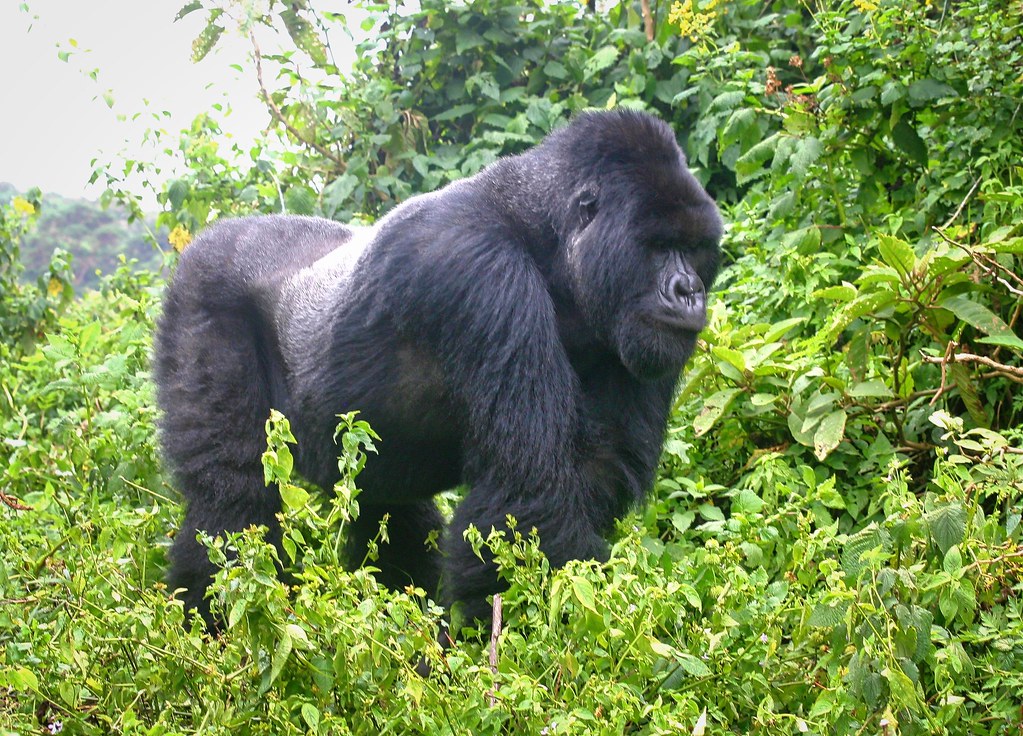
Unlike mountain gorillas, adapted to cool, high-altitude forest, western lowland gorillas live in the hot, humid rainforest of the Congo Basin, across countries including Gabon, Cameroon and the Central African Republic. This lower elevation and warmer climate shapes their appearance noticeably: lowland gorillas carry shorter, often browner or auburn-tinged fur compared to the thick black coat of a mountain gorilla, an adaptation that makes sense given how much less thermal insulation a lowland forest environment demands.
A Fruit-Rich Diet
This higher fruit intake also means lowland gorilla ranging patterns tend to shift more with the seasons than mountain gorilla movement typically does, since troops follow the fruiting cycles of specific tree species across their home range rather than relying on the more consistently available leaf and bamboo resources mountain gorillas depend on regardless of season.
Where mountain gorillas rely heavily on leaves and bamboo shoots due to limited fruit availability at altitude, lowland gorillas have access to a considerably more fruit-diverse diet year-round, supplemented by leaves, bark and, notably, a much higher recorded rate of insect consumption, particularly termites and ants, than has been documented in mountain gorilla populations. This dietary difference reflects genuine ecological divergence between the two subspecies rather than simple regional preference.
Life Around Forest Clearings
Researchers first began systematically documenting bai behaviour in the 1990s, and the clearings quickly became recognised as some of the most valuable wildlife research sites in Central Africa, offering rare, sustained visual access to species that spend the overwhelming majority of their time hidden within dense forest cover elsewhere in their range. Long-term observation platforms built at the edges of well-known bais now support both ongoing scientific research and the small but growing tourism industry built around lowland gorilla viewing, with the two uses generally complementing rather than conflicting with each other given how much baseline behavioural data researchers have already gathered from these same locations over multiple decades of study.
One of the most distinctive aspects of lowland gorilla habitat is the presence of natural forest clearings, known locally as bais, where mineral-rich soil and open sightlines draw gorillas out of dense cover into more visible open ground, often alongside forest elephants and forest buffalo at the same watering points. These clearings, most famously documented in places like Central African Republic’s Dzanga-Sangha reserve, offer some of the clearest wild gorilla viewing opportunities anywhere in Africa, since gorillas here are visible in open terrain rather than glimpsed through dense understory vegetation the way a mountain gorilla trek typically unfolds.
Social Structure Broadly Similar, With Key Differences
Researchers who have spent extended time observing both subspecies note that lowland gorilla groups appear somewhat more tolerant of temporary proximity to neighbouring troops around shared bai clearings than mountain gorilla groups typically are within their own more forested, distance-maintained territories, possibly because the shared draw of a mineral-rich clearing outweighs the usual incentive to avoid contact with a rival troop.
Bais: Nature’s Own Viewing Platforms
Few other wildlife viewing locations anywhere on the continent offer this kind of natural, multi-species concentration in one fixed, easily observed spot.
The ecological function of a bai extends well beyond gorilla viewing convenience. These clearings form around mineral-rich soil and water sources that many forest species, not just gorillas, actively seek out to supplement dietary minerals unavailable elsewhere in the surrounding rainforest. Elephants, buffalo, and various forest antelope species use the same clearings, sometimes within the same viewing session as a gorilla troop, making a single afternoon at a well-known bai like those found in Dzanga-Sangha one of the more efficient wildlife-viewing experiences available anywhere in Central Africa, since multiple species converge on the same open ground rather than requiring separate excursions to find each one.
Lowland gorilla troops follow the same basic silverback-led family structure seen in mountain gorillas, though troop sizes tend to run somewhat smaller on average, and interactions between neighbouring lowland gorilla groups appear less rigidly territorial than has been documented in some mountain gorilla populations, possibly reflecting the more dispersed, fruit-tree-dependent foraging pattern that lowland forest life requires. Silverbacks still play the central defensive and decision-making role within the troop, though the more open, fruit-patch-based foraging strategy of lowland gorillas sometimes results in temporary splitting and rejoining of troop members in ways less commonly observed among mountain gorillas.
A Subspecies Under Serious Threat
Vaccination trials and improved disease-monitoring protocols developed in response to past Ebola outbreaks now form part of ongoing conservation work at several lowland gorilla research sites, an active area of veterinary conservation research that has no real parallel in mountain gorilla conservation, where disease risk comes overwhelmingly from human-to-gorilla transmission rather than the periodic viral outbreaks lowland gorilla populations have had to contend with.
Western lowland gorillas are classified as Critically Endangered, a more severe status than mountain gorillas currently hold, driven by a combination of habitat loss from logging, commercial bushmeat hunting, and repeated outbreaks of Ebola virus disease that have devastated some populations, in certain documented cases killing off the majority of a local gorilla group within a single outbreak. This disease vulnerability adds a layer of conservation urgency beyond the habitat and hunting pressures facing mountain gorillas, since disease outbreaks can spread through a population far faster than habitat loss alone.
What A Bai Sighting Involves In Practice
Photographers in particular tend to appreciate this format, since the fixed viewing position and open sightlines across a bai make for considerably easier equipment setup and steadier shooting conditions than the fast-moving, obstructed forest photography a mountain gorilla trek or chimpanzee trek typically demands.
Viewing gorillas at a bai typically means settling into a fixed, elevated observation platform at the clearing’s edge for an extended period, sometimes several hours, rather than actively trekking toward a moving troop the way East African gorilla trekking works. This more passive, patient viewing style rewards visitors willing to sit quietly and let the clearing’s activity unfold naturally, since gorillas, elephants and other wildlife move in and out of a bai on their own schedule rather than a fixed one-hour visitor window. It is a genuinely different rhythm from a mountain gorilla trek, less physically demanding but requiring a different kind of patience from visitors more accustomed to the shorter, more structured East African format.
Seeing Lowland Gorillas For Yourself
Anyone weighing this subspecies against the more familiar mountain gorilla trekking circuit should treat the comparison as a genuine choice between two different but equally legitimate wildlife experiences, rather than assuming one option is simply a lesser substitute for the other. Travellers wanting to encounter this subspecies specifically need to look toward the Congo Basin rather than East Africa’s more established gorilla trekking circuit. Our combination safari tours and photography-focused itineraries through Gabon, Cameroon and the Central African Republic are built around exactly this kind of encounter, typically involving more remote logistics and a genuinely different visual experience than East African mountain gorilla trekking, with sightings often occurring in open bai clearings rather than dense understory. Given the more complex logistics involved in reaching these destinations, we recommend getting in touch through our contact page well ahead of your intended travel dates so we can plan transport and permits accordingly.