
The Primate Whose Social Politics Look Uncomfortably Familiar
Guides leading savannah game drives often note that baboon sightings generate a different kind of visitor reaction than more dramatic species like elephants or lions, less immediate awe and more a kind of uneasy recognition, as travellers watch social dynamics play out that feel closer to a workplace or family drama than to typical wildlife-documentary footage. That reaction is not accidental. Baboon society genuinely does map onto recognisable human patterns of status, alliance and reconciliation more directly than almost any other species encountered on a standard African safari itinerary.
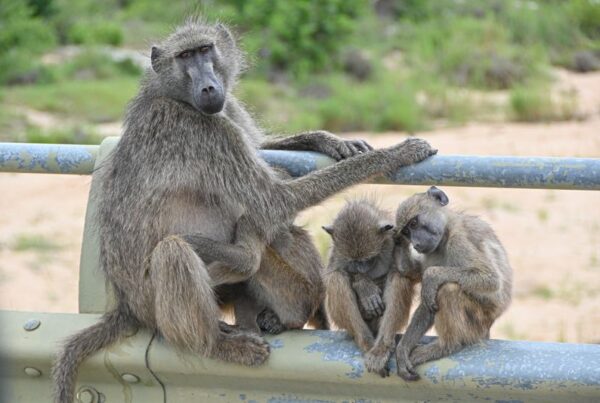
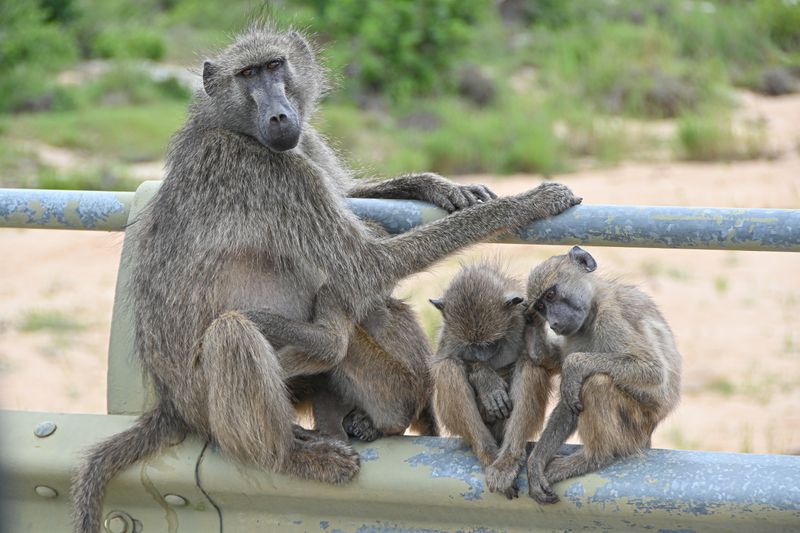
No African primate on a typical safari itinerary offers a clearer window into raw social hierarchy than the baboon. Watching a troop for even twenty minutes tends to reveal a running drama of alliances, discipline, reconciliation and status anxiety that researchers have spent decades documenting in detail, precisely because baboon society maps onto recognisably human social dynamics more closely than almost any other primate encountered on safari.
Five species of baboon exist across Africa and the Arabian Peninsula, with the olive, yellow and chacma baboons being the ones most commonly encountered across our destination countries. Despite regional variation in coloring and size, the core social structure and behaviour remain broadly consistent across the genus, which is part of why baboon troops feel so immediately legible to human observers regardless of which specific species is in front of them.
Life In The Open, Not The Forest Canopy
Adult male baboons are considerably larger than females, sometimes twice the body weight, a size difference more pronounced than in most other African monkey species and closely tied to the intense male-to-male competition for troop rank and mating access described later in this guide. That same size disparity, combined with the long, dagger-like canine teeth adult males carry, is part of why a mature male baboon commands a level of physical presence that first-time visitors often find more intimidating up close than a gorilla, despite gorillas being considerably larger animals overall.
A Savannah Specialist
Unlike colobus monkeys or golden monkeys, baboons are largely terrestrial, spending the majority of their time on the ground across savannah, woodland and rocky outcrop habitat rather than in the forest canopy. This ground-based lifestyle exposes them to more predator pressure than tree-dwelling primates, which has shaped much of their social behaviour toward group vigilance and coordinated defence.
An Omnivorous, Opportunistic Diet
Baboons eat an unusually broad diet for a primate, including grasses, roots, fruit, insects and occasionally small vertebrates, an adaptability that lets troops thrive across habitats too dry or resource-poor for more specialised primates. This same opportunism is what drives baboons into conflict with farms and lodges in some areas, where crop-raiding troops can cause real economic damage to nearby communities.
A Rigid, Visible Hierarchy
What makes baboon hierarchy particularly interesting to researchers is how consistently rank correlates with measurable stress hormone levels across the troop, with lower-ranking individuals, particularly males lacking strong alliances, showing chronically elevated stress markers compared to higher-ranking or well-supported troop members. This research, conducted over long-term studies of wild baboon populations, has become an influential model for understanding how social rank and support networks affect physiological stress more broadly, extending well beyond primatology into fields studying human social hierarchy and health outcomes.
Baboon troops are organised around clear, often visibly enforced dominance hierarchies among both males and females, with rank affecting everything from feeding order to mating access to which individuals receive grooming attention from others. Female rank is inherited maternally and tends to remain remarkably stable across generations within a troop, while male rank is won and lost through direct physical challenge and shifting alliances, occasionally involving serious aggression between rival males vying for top position.
Reconciliation behaviour after conflict, one baboon approaching a former rival to groom or present submissively, has been documented extensively by primatologists and is thought to serve a genuine social repair function within the troop, reducing the risk of prolonged, costly conflict between individuals who need to continue living in close proximity.
Communication Through Sound And Gesture
Infants and juveniles also use a distinct set of distress and play vocalisations that adult troop members respond to differently depending on context, part of a communication system layered enough that experienced researchers can often distinguish individual baboons by voice alone after sufficient time spent with a particular troop.
Baboons use an extensive vocal repertoire including grunts, barks and a distinctive two-syllable contact call used to locate scattered troop members across open terrain, alongside a range of facial expressions and postures that communicate everything from submission to aggressive intent. A yawn displaying the canine teeth, often mistaken by first-time observers for tiredness, actually functions as a dominance and threat display among males rather than a sign of relaxation.
Five Species, One Recognisable Pattern
Hybridisation between neighbouring baboon species does occur in the narrow zones where two ranges meet, and researchers studying these contact zones have used baboon hybrid populations as a useful model for understanding how closely related primate species diverge and occasionally re-mix at their geographic edges, adding yet another layer to why this genus has attracted such sustained scientific interest over the decades.
Olive baboons range across a broad band of central Africa including Uganda and western Kenya, yellow baboons occupy savannah further east and south including parts of Tanzania, and chacma baboons, the largest of the five species, dominate southern Africa. Guinea baboons and hamadryas baboons occupy smaller ranges in West Africa and the Horn of Africa respectively, both largely outside our current destination countries. Despite these regional differences in size and coloring, from the tan-grey coat of an olive baboon to the more golden tone of a yellow baboon, the underlying troop structure, dominance dynamics and vocal repertoire remain broadly consistent across the genus, which is why baboon behaviour research from one region tends to generalise reasonably well to populations elsewhere in Africa.
Why Baboons Matter To Human Evolution Research
Long-term baboon field studies, some spanning multiple decades and tracking known individuals across their entire lifespans, have become foundational to broader primatology methodology, establishing techniques for individual identification, genealogical tracking and behavioural coding that researchers studying other primate species, including gorillas and chimpanzees, have since adapted for their own long-term field programs.
Baboons hold a particular significance in anthropology beyond their own biology. Because they are one of the few primates that successfully transitioned from forest to open savannah habitat, much like early hominins are believed to have done, researchers have long studied baboon social structure and behaviour as a partial model for understanding the pressures that may have shaped early human social evolution. This is not a claim that baboons are somehow proto-human, but rather that a savannah-adapted primate living in large, hierarchically organised troops offers useful comparative insight into how social complexity might develop under similar ecological pressures, a research angle that has made baboons one of the most closely studied primates in the field alongside chimpanzees.
Not Especially Dangerous, But Not To Be Underestimated
Wild baboons rarely pose a genuine threat to visitors who maintain sensible distance and do not carry visible food, though adult males possess canine teeth larger than a lion’s and can inflict serious injury if provoked or cornered. Most negative encounters stem from baboons habituated to human food near lodges or picnic sites rather than genuine predatory aggression, which is why guides consistently advise against feeding baboons or leaving food visible in vehicles and rooms across baboon territory.
A Typical Day In A Baboon Troop
Guides leading game drives through baboon territory can often predict roughly where a troop will be at a given hour simply from knowing this daily rhythm, a level of behavioural predictability that makes baboon sightings some of the more reliably timed encounters on a standard savannah itinerary.
Baboon troops generally move as a cohesive unit through their home range each day, beginning with a period of grooming and social reinforcement shortly after waking, followed by extended foraging bouts that can cover considerable ground given how varied their diet is. Midday often brings a rest period, particularly in hot weather, with the troop clustering in shade for grooming and, among juveniles, extended bouts of play that closely mirror the rough-and-tumble behaviour seen in young gorillas and chimpanzees. Evening brings the troop back toward a safe sleeping site, often cliffs, large trees or rocky outcrops that offer some protection from ground predators overnight, with the same sites frequently reused across many consecutive nights if conditions remain favourable and undisturbed.
Seeing Baboons For Yourself
Baboon troops feature prominently on our baboon and savannah primate observation tours across Kenya, Tanzania and Uganda’s savannah parks, usually as part of a broader game drive alongside elephants, lions and other wildlife rather than a dedicated excursion. No special permit is required, making this one of the more accessible primate encounters on any itinerary. For a longer look at how baboon sightings pair with a wider wildlife safari, see our combination safari tours, or reach out through our contact page to build one around your dates.