
Africa’s Most Widespread Monkey, And One Of Its Most Studied
Because vervets are so consistently present across so many itinerary stops, rather than the focus of a single dedicated excursion, it is easy for travellers to underrate them relative to rarer, harder-won sightings like gorillas or chimpanzees. Guides who have spent years around both tend to push back on that instinct, pointing out that the sheer density of documented vervet behaviour research, built from decades of easy access to habituated wild populations, has produced insights into primate cognition and communication that rarer, more elusive species have been far harder to study in comparable depth.
If chimpanzees and gorillas represent the rare, hard-won encounters of a primate safari, vervet monkeys represent something closer to the opposite: a species so widespread and adaptable across sub-Saharan Africa that most travellers will see one within their first day, often around lodge grounds or roadside picnic stops, well before their first scheduled trekking excursion. That familiarity has made vervets one of the most extensively studied primates in the wild, particularly around questions of social learning and alarm communication.
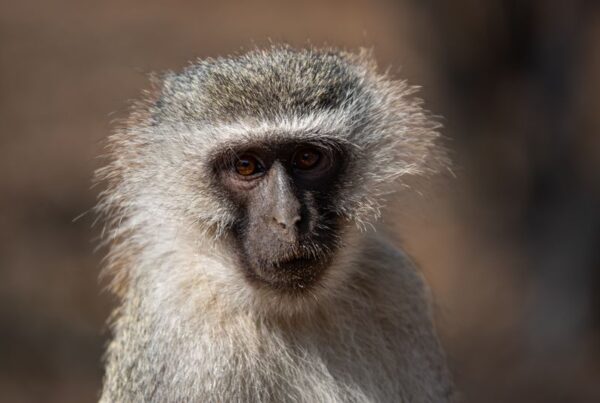
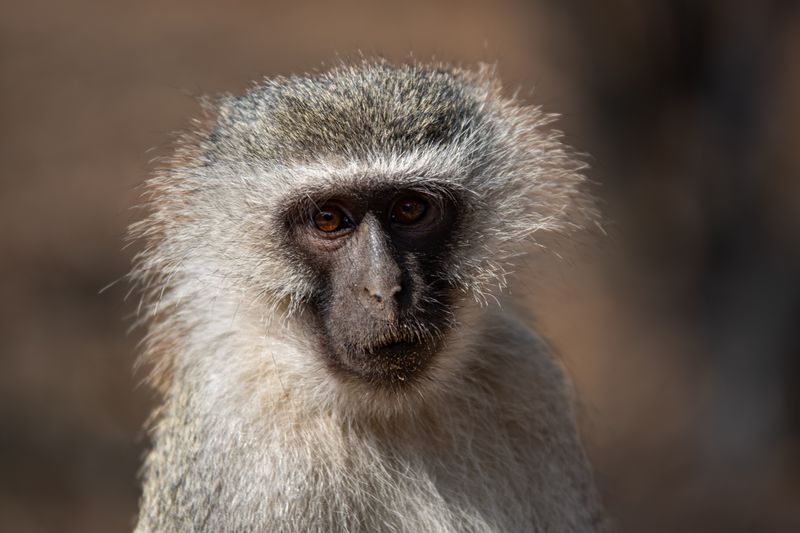
Grey-brown fur, a black face and, in adult males, a strikingly blue-tinged scrotum used in social signalling, make vervets easy to identify at a glance. Their true significance to primatology, though, lies less in appearance and more in what decades of field research have revealed about how they think and communicate.
A Species Built For Adaptability
Vervet monkeys hold the distinction of being one of the most widely translocated primates in modern history, with populations established outside Africa entirely through human transport centuries ago, most notably on several Caribbean islands where descendants of vervets carried on colonial-era ships still persist today as a naturalised, self-sustaining population. This history is a curiosity rather than something travellers encounter directly on an African primate safari, but it underlines just how readily this particular species adapts to entirely new environments, a trait that shows up just as clearly in how comfortably wild African vervet populations coexist with expanding human settlement today.
Comfortable Across Many Habitats
Vervet monkeys thrive across savannah woodland, riverine forest and the edges of human settlements alike, a flexibility that sets them apart from more habitat-restricted species like golden monkeys or colobus monkeys. This adaptability means vervets are encountered across virtually every one of our destination countries, often in multiple habitat types within the same national park.
Living Alongside Humans
That same adaptability creates real friction near lodges, farms and towns, where vervets readily raid crops and food stores, a behaviour that has made them something of a mixed blessing in areas where tourism and agriculture sit close together. Guides generally advise keeping food out of sight and windows closed at lodges in vervet territory, not out of danger but simply to avoid an opportunistic monkey helping itself to breakfast.
The Alarm Call System That Changed Primatology
What makes this system so scientifically significant is the specificity of the response it triggers. Monkeys hearing the leopard call scramble into trees, since leopards are ground predators; those hearing the eagle call look upward and dive into dense cover, since an eagle attacks from above; and the snake call prompts monkeys to stand upright and scan the surrounding grass, since the appropriate response to a snake threat is visual detection rather than fleeing to any particular location. Researchers testing this by playing recorded calls back to troops in the absence of any real predator found that monkeys still produced the correct, predator-appropriate response purely from the sound itself, strong evidence that the calls function as genuine categories of information rather than a single generic distress signal.
Vervet monkeys are famous in scientific circles for a specific discovery: they use distinct, structurally different alarm calls for different predator types, a leopard-specific call, a separate eagle-specific call, and a third for snakes, each triggering a different, appropriate evasive response from troop members who hear it. This was one of the first documented examples of what researchers call functional reference in a non-human species, calls that behave somewhat like words pointing to specific external threats rather than simply expressing generalised alarm. Young vervets are not born knowing these calls correctly and visibly refine their alarm-calling accuracy through observation and correction from older troop members over their first year of life, a genuine example of social learning in the wild.
Social Structure And Troop Life
This inherited rank system means a vervet born to a high-status mother enters the troop with a considerable social advantage already in place, an inherited position that shapes access to feeding sites, grooming partners and, eventually, mating opportunities well before the individual has done anything to earn that standing directly.
Vervet troops typically number twenty to fifty individuals, organised around a stable core of related females, with males transferring between troops upon reaching maturity in a dispersal pattern common across many Old World monkey species. Female rank is inherited directly from the mother and tends to remain stable across a female’s lifetime, creating clear, persistent hierarchies that researchers have tracked across multiple generations in some long-term study populations, particularly in East Africa.
An Unexpected Role In Human Medical Research
This same physiological closeness has also made wild vervet populations useful subjects for observational research into naturally occurring conditions, since certain metabolic and cardiovascular patterns seen in humans appear to develop spontaneously in some wild and semi-wild vervet populations, offering researchers a window into disease processes without the ethical and practical constraints of inducing those conditions directly.
Vervet monkeys share enough physiological similarity with humans that captive-bred colonies, entirely separate from the wild populations travellers encounter on safari, have played a significant role in medical research for decades, including work on cardiovascular disease, diabetes and neurological conditions. This research use is worth mentioning largely to draw a clear line: the vervets living wild in Kenya, Tanzania, Uganda and Rwanda are unrelated to any research population, and their presence on safari itineraries has nothing to do with laboratory use elsewhere. It does, however, underline how closely vervet biology mirrors human biology in ways not always obvious from a casual roadside sighting.
Telling Vervets Apart From Similar Monkeys
Patas monkeys, another species sharing parts of the same savannah range, are more reliably distinguished by their notably reddish coat and longer limbs built for ground-based sprinting rather than tree cover, a body plan and colouring different enough from the grey, more tree-comfortable vervet that confusion between the two is less common once a traveller has seen both species side by side even briefly.
First-time visitors sometimes confuse vervet monkeys with other grey or brown monkey species sharing similar habitat. The clearest identifying features are the vervet’s black face rimmed with white fur, a grey-brown body coat, and, in males, the distinctive blue-tinged genital coloring used in social signalling. Guenons, a broader group of forest monkeys that includes several regionally distinct species, often share a generally similar body size but typically show more varied facial coloring and patterning than the relatively uniform vervet. Asking your guide to point out the specific distinguishing features in the moment is usually faster and more reliable than trying to identify a species from memory alone, particularly for travellers seeing several different monkey species across a single trip.
Where You Will Actually See Them
Unlike species that require a dedicated permit and pre-dawn trek, vervet monkeys turn up incidentally across almost every itinerary, from savannah game drives in Kenya and Tanzania to forest lodge grounds in Uganda and Rwanda. Their sheer visibility makes them a good species for restless children or first-time safari travellers still adjusting to patient wildlife-watching, since sightings require no special timing or luck.
Managing A Close Encounter Sensibly
Lodge staff across vervet territory are generally well practised at gently discouraging troop members from lingering too close to dining areas, and following their lead rather than improvising your own approach tends to keep the interaction relaxed for everyone involved, guests and monkeys alike.
Because vervets are so habituated to human presence around many lodges, it is easy to forget they remain wild animals rather than tame ones. Direct feeding, even accidental, tends to escalate a troop’s boldness quickly, sometimes leading to monkeys entering rooms or vehicles in search of food within just a few encounters. Guides generally recommend keeping windows and doors closed when vervets are visible nearby, storing food out of sight rather than in easily opened bags, and avoiding direct eye contact at close range, which some individuals interpret as a challenge. None of this reflects genuine danger from a species this small, but it does keep encounters pleasant for both visitors and the monkeys themselves, rather than turning into a battle over an unattended breakfast plate.
Where Vervets Fit Into A Primate Safari
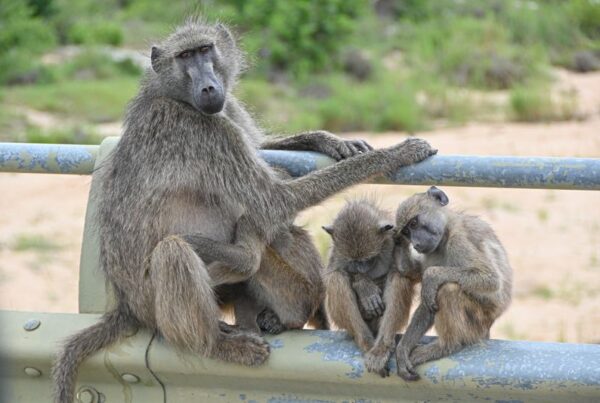
Our baboon and savannah primate observation tours regularly include vervet sightings alongside baboon troops, since the two species often share the same open savannah habitat. They also appear frequently on forest nature walks in more wooded settings. Neither requires special booking beyond your standard itinerary, though if you want a trip specifically built around easier, lower-intensity primate viewing for a mixed-age group, mention that through our contact page and we will weight the itinerary accordingly.