
The Monkey That Named Itself After What It Lacks
Guides across our destination countries often describe colobus monkeys as the easiest primate to photograph well despite the challenge of canopy-level lighting, simply because the extreme contrast between the black body and flowing white mantle reads clearly even in dappled forest light where more uniformly coloured animals tend to blend into shadow. That same visual boldness against green foliage is likely part of why colobus troops remain relatively easy for guides to spot from the ground even when perched high in the upper canopy, a practical advantage on nature walks that do not have the benefit of a dedicated tracker locating the group in advance the way a permitted gorilla or chimpanzee trek does.
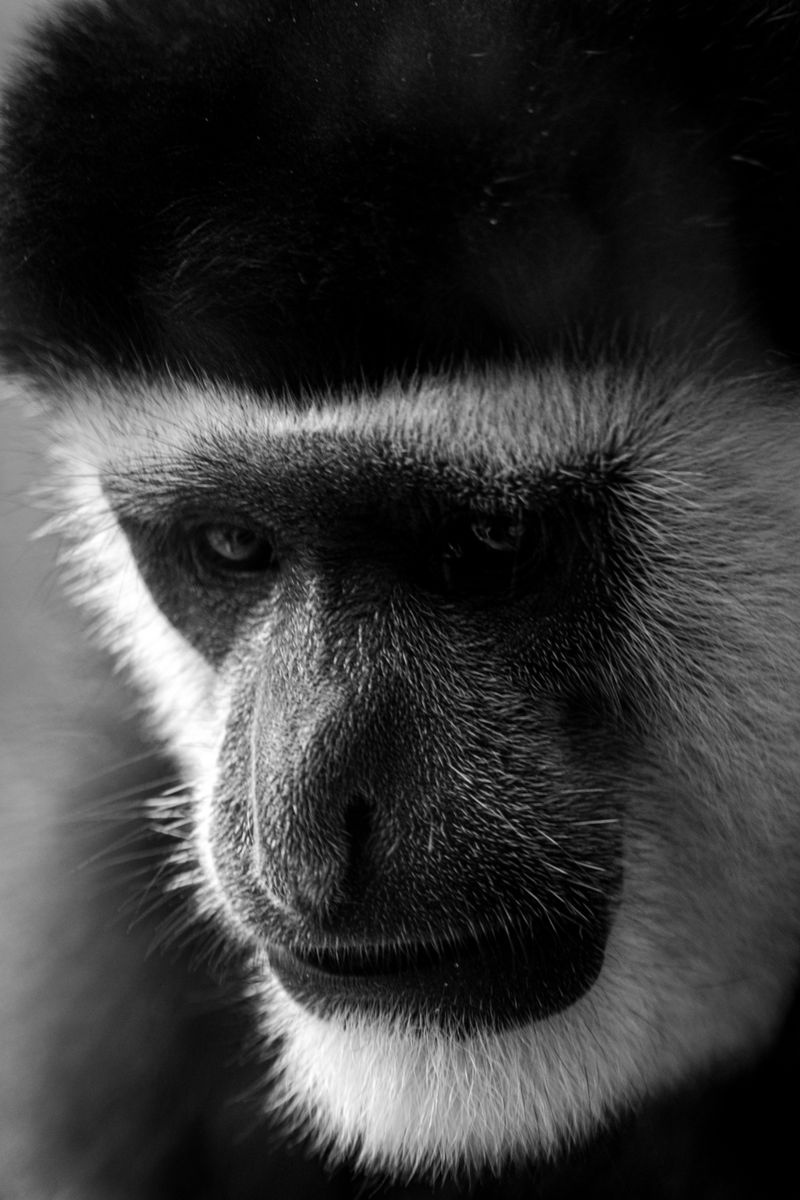
The word colobus comes from the Greek for “mutilated,” a reference to the near-total absence of a thumb on this monkey’s hand, an adaptation for fast, committed movement through the canopy rather than careful, deliberate grasping. It is an odd naming choice for an animal that is otherwise one of the more visually striking primates a traveller will encounter in East and Central African forests, with a flowing cape of long white fur draped over a jet-black body and a bushy white tail trailing behind it in flight between branches.
Black-and-white colobus monkeys, most commonly the mantled guereza subspecies encountered across our destination countries, are Old World monkeys built almost entirely for life above the forest floor, and understanding that specialisation explains most of what makes them distinctive to watch.
Built For The Canopy, Not The Ground
Infant colobus monkeys are born with a striking, near-pure white coat that darkens gradually toward the adult black-and-white pattern over their first several months of life, a colouring difference stark enough that first-time visitors sometimes mistake an infant for an entirely different species until a guide clarifies. This bright natal coat is thought to help troop members, particularly other females, locate and attend to infants more easily within the dense forest canopy, and infant colobus monkeys are frequently passed between related females for handling and grooming in a pattern researchers call allomothering, more pronounced in colobus troops than in many other primate species.
The Missing Thumb
Where most primates use an opposable thumb for precise grasping, colobus monkeys have a reduced, vestigial thumb, trading fine grip strength for a hook-like hand shape better suited to fast, committed leaps between branches. This is not a disadvantage in their actual habitat. Colobus monkeys are among the most agile leapers in the primate world, capable of jumping distances that look genuinely reckless from the ground, using their long limbs and flowing tail for balance mid-air rather than a careful, hand-over-hand climbing style.
An Almost Entirely Arboreal Life
Unlike baboons or vervet monkeys, which spend considerable time on the ground, colobus monkeys rarely descend from the canopy at all, foraging, sleeping and socialising within the upper forest layers. This habit makes them somewhat easier to spot on a guided forest walk than more ground-shy species, since their bright coloring and constant canopy movement stand out clearly against green foliage once a guide points a troop out.
A Leaf-Based Diet And The Stomach To Match
This fermentation process, while effective, is also relatively slow, which means colobus monkeys spend considerably more of their day resting and digesting than more fruit-reliant primates that can extract energy from their food more quickly. Long, still resting periods between feeding bouts are entirely normal colobus behaviour rather than a sign of illness or disturbance, something guides often explain to visitors who expect constant activity from every primate sighting. It also means colobus troops tend to occupy a smaller home range relative to their body size than more active foragers, since a dense patch of quality leaf cover can sustain a troop for extended periods without needing to travel far.
Colobus monkeys are almost entirely folivorous, meaning their diet is built around leaves rather than fruit, a rarity among African monkeys. To digest the tough cellulose and often mildly toxic compounds found in mature leaves, colobus monkeys have evolved an enlarged, multi-chambered stomach that ferments plant material somewhat similarly to how a cow digests grass, an unusual convergent adaptation among primates. This dietary specialisation also explains why colobus monkeys can thrive in forest areas with relatively low fruit availability, since leaf material is abundant and available year-round in a way ripe fruit is not.
Social Structure And Group Life
Male colobus monkeys typically disperse from their natal troop upon reaching maturity, a pattern that helps limit inbreeding within these relatively small, closed social units, while related females generally remain together across their lifetimes, forming the stable, cooperative core that handles most infant care within the group.
Colobus troops are generally smaller than the large, sprawling groups seen in baboons or golden monkeys, typically eight to fifteen individuals organised around one or several adult males and a group of related females. Vocal communication includes a distinctive deep, roaring call used primarily at dawn and dusk to advertise territory to neighbouring troops, a sound many first-time visitors mistake for something considerably larger than a monkey when they hear it echoing through the forest before sunrise.
Colobus Monkeys As Ecosystem Engineers
Researchers studying forest regeneration patterns have found measurable differences in seedling density and species diversity between forest patches with healthy colobus populations and those where colobus numbers have declined, evidence strong enough that some conservation programs now factor colobus population health directly into broader forest management planning rather than treating the species as simply one more primate worth protecting for its own sake.
Because colobus monkeys eat such large volumes of leaf material and range widely across the canopy each day, they play a disproportionately large role in seed dispersal and vegetation cycling relative to their body size. Seeds passed through a colobus digestive tract are often more likely to germinate successfully than seeds that simply fall, a phenomenon researchers have documented across several tropical forest systems. A healthy colobus population, in other words, is not just a pleasant sighting for visitors but an active contributor to the forest regenerating itself, part of why conservation organisations track colobus numbers as one indicator of overall ecosystem health.
Beyond The Black-And-White: Other Colobus Species
The black-and-white colobus most commonly seen across our destinations represents only part of a wider colobus family. Red colobus monkeys, found in scattered populations across Central and East Africa, are considerably more threatened, with several subspecies classified as Critically Endangered due to a combination of habitat loss and, in some regions, direct hunting pressure that black-and-white colobus populations have largely avoided. Olive colobus monkeys, smaller and far less visually striking, live in West African forests outside our current destination range. The relative visibility and stability of black-and-white colobus populations across Uganda, Rwanda and the Congo Basin is one reason this particular species has become the face of colobus encounters for most safari travellers, even though it represents only one branch of a more diverse and, in places, considerably more endangered family.
Where To Find Them Across Our Destinations
Local variation in mantle length and tail bushiness across regions gives even experienced guides a way to make an educated guess at roughly which forest a particular colobus population calls home, purely from subtle differences in coat presentation.
Black-and-white colobus monkeys turn up reliably across forest walks in Uganda’s Bwindi and Kibale forests, Rwanda’s Nyungwe Forest, and the Congo Basin countries further west including Gabon and Cameroon, though the exact subspecies and coloring pattern varies somewhat by region. Their reliance on intact canopy cover means healthy colobus populations are often a reasonably good indicator of overall forest health in a given area, since they are more sensitive to canopy fragmentation than more ground-adaptable species.
Predator Pressure And The Value Of Group Living
Chimpanzees, discussed elsewhere in this guide as opportunistic hunters, also prey on colobus monkeys in several well-studied populations, adding a second, less-expected predation pressure from a fellow primate rather than solely from birds of prey.
Crowned eagles are among the most significant predators of colobus monkeys across much of their range, capable of taking juveniles and even adult females from the canopy with little warning. This predation pressure has shaped colobus group behaviour meaningfully, favouring troops that maintain reasonable size and vigilance rather than dispersing into smaller, more vulnerable units. Adult males within a troop have been observed engaging in coordinated defensive behaviour against eagle threats, including loud vocal mobbing intended to drive a hunting eagle away from the group, a level of cooperative defence that is not universal across all monkey species and adds another layer to what makes colobus social structure worth watching closely on a forest walk.
Seeing Colobus Monkeys For Yourself
Colobus sightings feature prominently on our forest monkey tracking and nature walk tours, a lower-intensity alternative to gorilla or chimpanzee trekking that works well as a rest-day activity between more demanding treks, or as a primary primate experience for travellers who want a gentler pace. No special permit is required, and the walks suit most fitness levels and ages. Get in touch through our contact page to have a nature walk built into your itinerary alongside your main trekking days.