
A Flash Of Colour In A Forest Full Of Black And Grey
Travellers often arrive expecting the Virunga volcanoes to be a gorilla-only destination, only to discover that the same permit system and forest infrastructure supports an entirely different, equally memorable species within the same protected area. Golden monkeys rarely feature as prominently in pre-trip research as gorillas do, which means many visitors encounter genuine surprise at how vivid and active the sighting turns out to be, often ranking it among the most photogenic moments of their entire trip once they have actually experienced it firsthand rather than read about it in advance.
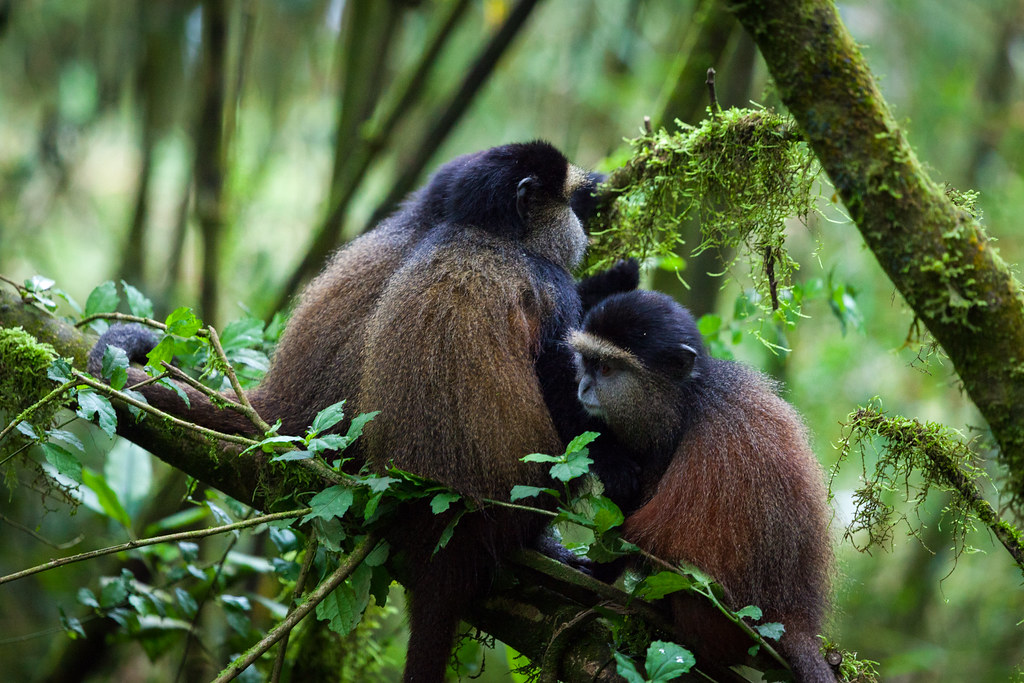
Most of the primates travellers come to Africa hoping to see are some shade of black, brown or grey, which is part of why the golden monkey stands out so immediately. Bright orange-gold fur across the back and flanks, framed by black limbs and a dark cap, makes this one of the most visually striking primates on the continent, and one confined to an almost absurdly small range: the bamboo zone of the Virunga volcanoes, shared between Rwanda and Uganda, and nowhere else on Earth.
Golden monkeys are a subspecies of the wider blue monkey group, technically classified as Cercopithecus mitis kandti, but the coloring alone justifies treating them as something distinct in the eyes of most visitors. Unlike the slow, deliberate movement of a gorilla troop, golden monkeys move fast, loud and constantly, which changes the entire character of the encounter.
A Range Defined By Bamboo
The golden monkey’s scientific classification has shifted over the decades as researchers have debated whether it warrants status as a full species or remains best understood as a striking subspecies of the wider blue monkey group found across East and Central Africa. That taxonomic debate matters less to a visiting trekker than the practical reality on the ground: whatever its formal classification, the golden monkey looks, moves and behaves distinctly enough from other blue monkey populations that guides and researchers alike treat an encounter with one as a genuinely separate experience from a general forest monkey sighting.
Living Inside The Volcanoes
Golden monkeys occupy the bamboo forest zone of the Virunga Massif specifically, the same volcanic mountain range that holds much of the world’s mountain gorilla population, at elevations that support dense bamboo growth. Volcanoes National Park in Rwanda and Mgahinga Gorilla National Park in Uganda both protect populations, though the total range is small enough that golden monkeys are considered range-restricted even within their own already-narrow habitat requirements.
A Diet Built Around One Plant
Bamboo shoots and leaves make up the bulk of a golden monkey’s diet for large stretches of the year, supplemented by fruit, flowers and invertebrates when available. This dependence on a single dominant food source is part of what ties the species so tightly to its narrow habitat, since bamboo forest at this specific elevation and rainfall pattern does not exist in many other parts of East Africa.
Large, Loud, Fast-Moving Troops
Because golden monkey troops are so large relative to a gorilla family, the sheer scale of activity during a sighting can feel overwhelming in the best sense: dozens of individuals moving, feeding and calling simultaneously across a relatively compact patch of bamboo, rather than the more contained, singular focus of watching one gorilla family. Younger monkeys in particular display near-constant play behaviour, chasing each other through the stems in bursts that can last several minutes before the group settles back into feeding, giving a golden monkey encounter a distinctly higher-energy character than most other primate sightings on a typical itinerary.
Golden monkey troops can number anywhere from thirty to over one hundred individuals, considerably larger than a typical gorilla family, and troop members constantly vocalise while foraging, a near-continuous chatter of chirps and calls that makes locating a troop by sound alone fairly straightforward for experienced trackers. Movement through the bamboo is fast and acrobatic, with monkeys leaping between adjacent stems rather than climbing deliberately, a visibly different rhythm from the slower pace of a great ape encounter.
Social structure within a troop follows a fairly typical Old World monkey pattern: related females form the stable core of the group across generations, while males often transfer between troops upon reaching maturity, a dispersal pattern that helps maintain genetic diversity across the small, geographically confined population.
Endangered But Overlooked
Compared to the global attention mountain gorillas receive, golden monkeys remain a relatively under-recognised conservation priority, despite facing genuinely comparable habitat pressure within the same protected forest system, a gap that awareness-focused tourism is only gradually starting to close.
Golden monkeys are classified as Endangered, a status driven almost entirely by the narrowness of their habitat rather than direct hunting pressure, since bamboo zone destruction or degradation removes their food source and living space simultaneously. Their restricted range means any habitat disturbance within the Virunga bamboo belt has an outsized effect on the total population compared to more widely distributed species. Conservation efforts here overlap heavily with mountain gorilla protection work, since both species depend on the same protected forest system, meaning ranger patrols and habitat protection funded by tourism benefit both species at once.
Photographing A Fast-Moving Subject
Golden monkeys present a genuinely different photographic challenge than the calm, still encounters typical of gorilla trekking. Troops rarely stay in one position for long, moving continuously through dense bamboo that creates a cluttered, high-contrast background of vertical stems and dappled light. A faster shutter speed than you might default to for gorilla photography helps freeze motion as monkeys leap between stems, and patience matters more than positioning, since a monkey that vanishes into the bamboo one moment often reappears in a clearer gap seconds later. Our primate photography tours can build extra time into a golden monkey excursion specifically for travellers who want more than a passing shot.
A Relatively Recent Addition To Primate Tourism
Before habituation efforts began, golden monkeys were known primarily through occasional sightings and limited scientific survey work, with far less accumulated behavioural data than gorillas had by the same point in their own tourism history. Habituating a troop involves the same patient, repeated-exposure process used for gorillas, though golden monkey troops present their own particular challenge given how large and fast-moving they are compared to a settled gorilla family, requiring habituation teams to work with a group that rarely stays in one place long enough for the slow, deliberate approach gorilla habituation typically allows.
Golden monkey tracking is a considerably newer tourism activity than gorilla trekking, only formalised as a regular visitor experience in the early 2000s once research confirmed habituated troops could tolerate visitor presence without significant stress. This recent history means golden monkeys have received less sustained conservation research funding than gorillas over the decades, despite facing comparable habitat pressure, a gap that tourism revenue is gradually helping to close as more operators add golden monkey tracking to standard Rwanda and Uganda itineraries.
Golden Monkeys Compared To Mountain Gorillas
Travellers booking a Rwanda or southwest Uganda itinerary often see both species within days of each other, and the contrast is part of the appeal. Where a gorilla encounter is calm, quiet and centred on one still, watchful family, a golden monkey encounter is fast, loud and visually vivid, with troops constantly in motion through the bamboo canopy. The permit cost reflects this difference too. Golden monkey tracking runs around a tenth of the price of a gorilla permit, and the trek itself is typically shorter and less physically demanding, making it an accessible add-on rather than a trip built around it alone.
Best Season And Time Of Day To Visit
Afternoon visits remain possible and still productive, though troops tend to spend more time resting during the heat of midday before a second, somewhat less intense feeding period in the late afternoon.
Golden monkey tracking runs year-round, unlike some primate activities that become genuinely difficult during the wettest months, since the bamboo zone drains reasonably well and the trek itself is short enough that heavy rain is more of an inconvenience than a barrier. Mornings tend to offer the most active viewing, since troops are typically feeding vigorously in the first hours after sunrise, producing the fast, constant movement that makes golden monkey encounters so visually distinct from the stiller pace of gorilla trekking. Guides generally recommend an early start regardless of season, both to catch peak activity and to avoid the midday heat that can settle over the lower slopes of the Virunga foothills.
Seeing Golden Monkeys For Yourself
Our golden monkey tracking tours run in both Rwanda’s Volcanoes National Park and Uganda’s Mgahinga sector, typically as a two-to-four hour excursion that pairs naturally with a mountain gorilla trek in the same general area. Because the trek is gentler and there is no strict minimum age, it also works well for families travelling with younger children who cannot join gorilla trekking under the standard fifteen-year age requirement. Reach out through our contact page to see how it fits into a Rwanda or Uganda itinerary.