
What A First-Timer Actually Needs To Know Before Booking
Treat the guidance below as the practical companion to the biology already covered elsewhere in this series, focused specifically on what changes about your actual trip planning and on-the-ground behaviour once baboons are part of the picture.
Like vervet monkeys, baboons rarely require a dedicated booking decision of their own. Unlike vervets, however, baboons are large, occasionally food-motivated, and genuinely capable of causing real disruption if a troop decides your vehicle or campsite is worth investigating, which makes practical guidance around them somewhat more important than the largely casual, low-stakes approach that suits vervet sightings. This guide focuses on where you will actually encounter baboons, how to behave sensibly around them, and how to fold a good sighting into whatever savannah-based activity you already have planned.
Why Baboons Deserve More Caution Than Other Common Monkeys
Adult male baboons can weigh considerably more than most people expect from a distance, and their canine teeth are genuinely impressive, evolved primarily for defence against predators and rivals within their own species rather than for use against humans, though a habituated troop that has lost its natural wariness can still present a real, physical concern in ways a vervet troop simply does not. This guide takes that difference seriously rather than treating baboons as interchangeable with the smaller, generally less assertive monkey species discussed elsewhere in this series.
Where You Will Actually See Baboons
A Near-Constant Presence In Savannah Country
Baboon troops are one of the most reliably encountered large mammals across savannah parks in Kenya, Tanzania and Uganda’s savannah regions, typically spotted during standard game drives rather than requiring any separate excursion. Troops can number in the dozens, making them hard to miss once you are in suitable open-country habitat.
Lodge And Campsite Populations
Similar to vervet monkeys, some baboon troops have become genuinely habituated around lodges, camps and picnic areas, and given their larger size and greater physical confidence, this habituation carries more real risk of food theft and occasionally intimidating close encounters than the equivalent vervet situation does. Many camps in baboon territory maintain strict food storage and door-closing policies specifically because of this.
What This Costs
No separate booking or advance planning is required for the cost side of this activity either, unlike almost every permit-based species discussed elsewhere in this series.
This is worth appreciating specifically because baboon sightings, despite costing nothing extra, often end up among the more genuinely engaging wildlife-viewing moments of an entire game drive day, simply because troop social dynamics unfold visibly and continuously in a way that more solitary or less socially active savannah species rarely offer for free within an already-booked activity.
Standard park entry and game drive fees cover baboon viewing without any separate permit or dedicated fee, since sightings happen as part of activities you are already paying for elsewhere in your itinerary via our baboon and savannah primate observation tours.
Safety Around Baboon Troops
Camps in known baboon territory often brief arriving guests specifically on local troop behaviour and any active precautions in place, and it is worth listening carefully to this briefing rather than assuming general wildlife caution automatically covers baboon-specific risk, since the particular combination of intelligence, physical strength and food motivation baboons display is not something every guest arrives already expecting.
Baboons are considerably stronger and more physically assertive than vervet monkeys, and a troop that has learned to associate humans with food can become genuinely pushy, sometimes approaching close enough to snatch items directly from hands or bags left open. Never attempt to feed baboons, keep vehicle windows closed when troops are nearby during a game drive, and treat any food left visible in a vehicle or tent as a real invitation for a determined troop to investigate. Guides accompanying game drives are well versed in managing baboon encounters safely and will generally keep appropriate distance automatically.
How Fit You Need To Be
Genuinely no consideration required here beyond whatever your broader game drive itinerary already assumes.
Not a relevant consideration for standard baboon viewing, since sightings happen from a vehicle during a game drive rather than through any walking-based trekking activity. This makes baboon viewing one of the most physically accessible primate encounters on this entire list, suitable regardless of mobility or fitness level.
A Realistic Walkthrough Of A Typical Sighting
Guides who spend regular time in a particular savannah region often know specific troops’ typical daily locations well enough to plan a game drive route that maximises the odds of a good, extended sighting rather than leaving it purely to chance, similar to the local knowledge that improves colobus and other forest monkey sightings on a nature walk.
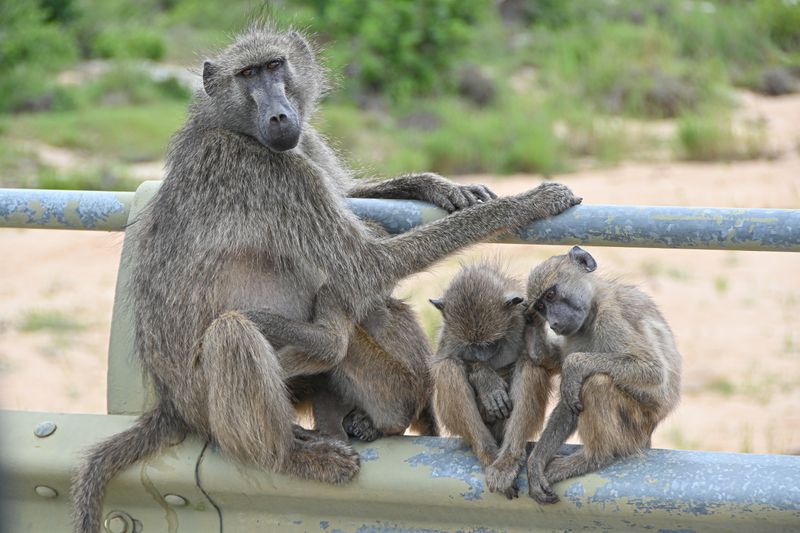
Most baboon encounters happen organically during a broader game drive, with troops visible foraging in open grassland, grooming along a roadside, or moving as a coordinated group between resting and feeding areas. Because troops are large and often quite visible against open savannah backdrop, extended viewing time is easy to arrange simply by asking your guide to pause rather than requiring any special scheduled activity.
Understanding What You Are Watching
Researchers studying wild baboon populations have documented stress and social hierarchy dynamics extensively enough that baboon field studies have influenced broader scientific thinking about social rank and physiological stress well beyond primatology itself, one of several reasons baboons are considered a genuinely significant research species rather than simply a common, easily seen savannah animal.
Baboon troops display one of the more rigid, clearly observable dominance hierarchies among African primates, and a bit of context makes a casual sighting considerably more interesting. Watch for a dominant male’s confident, unhurried movement through the troop, subordinate individuals grooming upward toward higher-ranking members, and the general deference lower-ranking baboons show when a dominant animal approaches a favoured resting or feeding spot. These dynamics play out constantly and are genuinely visible even during a brief roadside stop.
Combining This With Other Savannah Wildlife
This integration is one of the more efficient aspects of savannah-based wildlife viewing generally; unlike forest primates, which typically require dedicated tracking time separate from other activities, baboons and other savannah wildlife share the same open terrain and viewing windows, meaning a single well-paced game drive can deliver genuine variety without extending your day.
Baboon sightings blend naturally into broader game drive activity alongside elephants, lions and other classic savannah species, and our combination safari tours are built specifically around this kind of integrated wildlife viewing rather than treating primates and other wildlife as separate activities requiring separate time blocks.
What To Bring
Nothing else warrants special mention beyond the standard game drive kit already covered elsewhere in this series for other savannah species.
If you are travelling with young children specifically, it is worth reinforcing the no-feeding, windows-closed guidance directly with them before arriving in baboon territory, since the animals’ size and confidence can make an unsupervised child’s instinct to offer food or approach closely a genuine concern in a way it typically is not with smaller, more cautious primate species.
Standard game drive gear covers this fully: a reasonable zoom lens for photography, binoculars for extended viewing from a safe vehicle-based distance, and no special preparation beyond what your broader safari already requires.
Common First-Timer Questions
A final question worth addressing directly: whether baboons are worth photographing at all, given how common they are relative to rarer species elsewhere on an itinerary. Experienced wildlife photographers generally say yes, since the social behaviour on display, grooming, hierarchy, play between juveniles, offers genuinely compelling material even from an animal seen frequently throughout a trip.
A related question concerns tented camps specifically, where guests sometimes worry more about baboons than about larger, more obviously dangerous wildlife nearby. This concern is not unreasonable given how determined a food-motivated troop can be, though well-run camps in baboon territory have generally solved this through secure food storage and staff who actively discourage troops from lingering near guest tents, making the actual on-the-ground risk considerably lower than first-time visitors sometimes fear before arriving.
Travellers often ask how dangerous baboons actually are. Direct aggression toward humans who are not actively engaging with food is uncommon, but food-motivated boldness around habituated populations is genuinely worth taking seriously, more so than with vervet monkeys given the size difference involved. Others ask whether baboon viewing is worth a dedicated activity; for most itineraries already including savannah game drives, a specific booking is unnecessary since sightings happen reliably as a matter of course.
How Baboons Fit Into A Longer Trip
For travellers combining primate trekking in forest countries with a broader savannah safari, baboon sightings often provide a useful bridge between the two halves of the trip, a savannah primate encounter that feels connected to the forest gorillas or chimpanzees seen earlier in the same itinerary, even though the habitat and behaviour on display could hardly be more different day to day.
Planning Around This Species
Reach out through our contact page if baboon behaviour and social structure specifically interest you, and we can build in extra observation time during game drives in the savannah parks best known for large, active, easily observed troops.